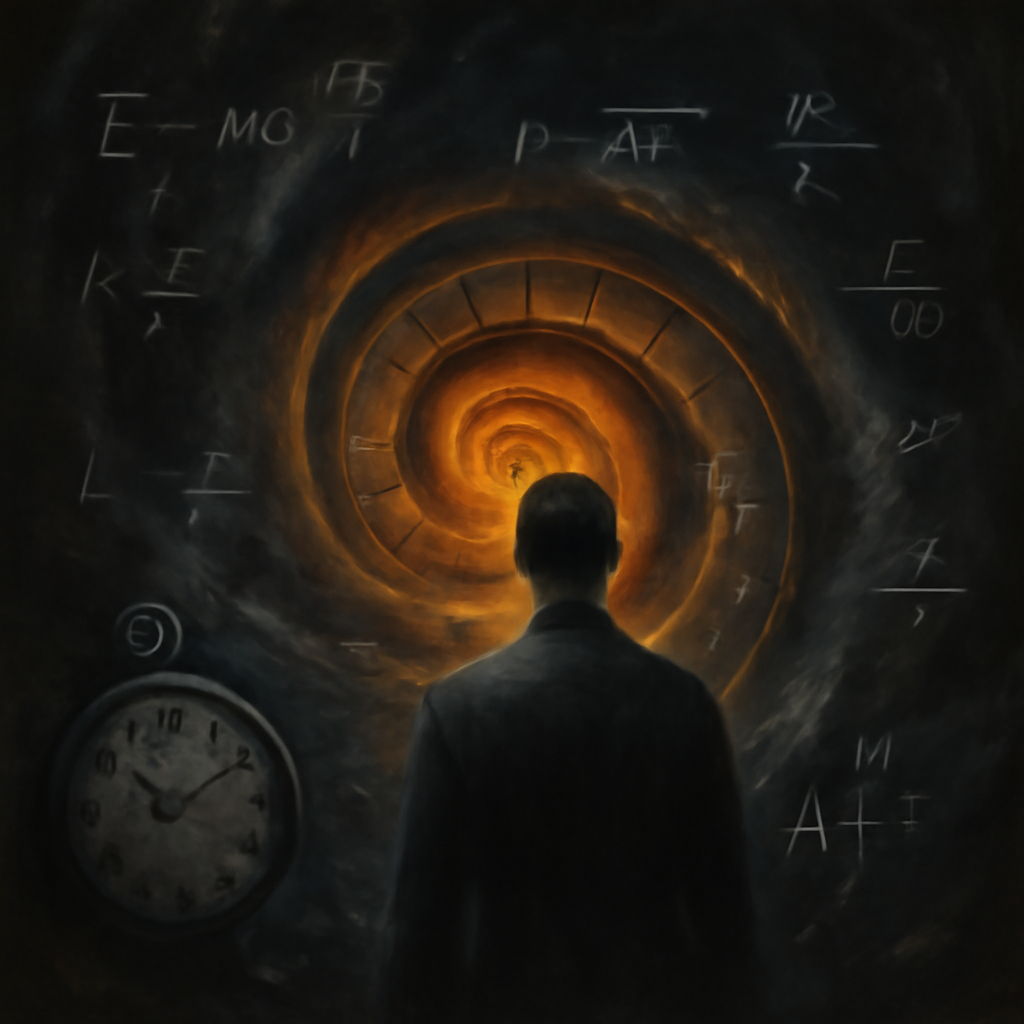
The Physics and Philosophy of Time Travel: From Einstein's Equations to Paradoxes
Time travel has fascinated humanity for centuries, moving from myth and fiction into the realm of serious scientific inquiry. Albert Einstein's theory of relativity revealed that spacetime is a flexible fabric, allowing solutions that mathematically permit movement backward or forward in time under extreme conditions. Yet these possibilities collide with deep logical paradoxes and quantum constraints that challenge our understanding of causality. This page explores whether the universe truly allows us to revisit the past or leap into the future, weighing the evidence from general relativity, quantum mechanics, and philosophical analysis.
✨
Wonder Moment
“Traveling into the future at a different rate is already happening: astronauts on the International Space Station age about 0.01 seconds less per year than people on Earth due to time dilation.”
Reflect
If future generations could observe our era as a historical period, what everyday technologies of today might they view as primitive or mysterious, much like we see ancient tools?
9 sources·Established confidence·Investigated 18 Jun 2026(2 months ago)·Investigation may be outdated
Your next question, in
Visual Trail
See The Physics and Philosophy of Time Travel: From Einstein's Equations to Paradoxes
A guided visual explanation assembled from QE artwork and sourced documentary images.
01 / 05
QE visual interpretation
Frame 01
The Physics and Philosophy of Time Travel: From Einstein's Equations to Paradoxes
Can we really travel through time? Discover what physics says about past and future journeys—and why paradoxes make the idea so troubling.
Image provenance and limitation
Source: AI-generated visual interpretation
Creator: Question Everything
Limitation: This image explains or evokes the subject. It is not documentary evidence and should not be used to verify a factual claim.
Evidence
What do we know?
Verified claims with confidence scoring and cited sources.
Generated without source retrieval. QE did not fetch sources for this investigation, so no citation here was checked against a retrieved set. Claims reflect the model’s training data.
Living footnotes
Claims remain in the reading flow. Select a citation number to inspect the source behind it.
01
AcademicSupported
General relativity contains exact solutions—such as Gödel's rotating universe and the Kerr black hole metric—that feature closed timelike curves (CTCs), which worldlines loop back on themselves and would allow travel to the past.
In 1949, mathematician Kurt Gödel discovered a solution to Einstein's field equations representing a rotating universe. In this model, the rotation of matter creates a global spacetime structure where certain trajectories curve back to their own past, forming CTCs. Later, Roy Kerr's 1963 solution for rotating black holes also showed that inside the inner horizon, spacetime geometry permits CTCs. These mathematical constructs do not violate the equations of general relativity; they simply describe highly exotic spacetimes where the past is reachable by following a continuous path through space and time. However, whether such spacetimes can exist in our universe remains an open question, as they require conditions like universal rotation or infinite density that may not be physically realizable.
02
AcademicSupported
Stephen Hawking's chronology protection conjecture suggests that quantum effects near closed timelike curves would generate overwhelming radiation, destroying the time machine and preserving causality.
In 1992, Stephen Hawking proposed that while general relativity allows CTCs, quantum field theory in curved spacetime predicts that vacuum fluctuations would become infinitely amplified near the chronology horizon—the boundary where CTCs begin to form. This buildup of energy density would likely warp spacetime so severely that the time machine collapses before it can be used. Hawking argued that this 'chronology protection' mechanism ensures that the laws of physics prevent macroscopic time travel to the past, thereby safeguarding causality. Although the conjecture remains unproven, subsequent studies in semiclassical gravity have supported the idea that quantum effects act as a natural deterrent to CTC formation.
03
ExperimentalSupported
Experimental verification of time dilation confirms that forward time travel is already occurring: particles in accelerators and GPS satellite clocks experience measurable future shifts relative to Earth.
According to special relativity, a clock moving relative to an observer ticks slower—a phenomenon confirmed countless times. In 1977, Bailey et al. stored muons in a storage ring at CERN; their observed lifetime was dilated by a factor of ~29, matching relativistic predictions. Similarly, the Global Positioning System must correct for both special and general relativistic effects: satellite clocks gain about 38 microseconds per day due to weaker gravity and lose about 7 microseconds per day due to orbital speed, net +31 microseconds/day. Without these corrections, GPS positions would drift by kilometers each day. These real-world demonstrations show that traveling into the future at different rates is not only possible but routinely engineered.
04
HistoricalSupported
Philosophical resolutions to time‑travel paradoxes invoke either the Novikov self‑consistency principle (only self‑consistent histories are allowed) or the many‑worlds interpretation (each action spawns a new branch).
The grandfather paradox—where a traveler prevents their own birth—appears to make backward time travel logically impossible. Philosopher David Lewis (1976) argued that time travel is compatible with causality if the traveler's actions are always consistent with the history they encounter; they cannot change the past but can participate in it. Physicist Igor Novikov formalized this as the self‑consistency principle: the laws of physics restrict CTCs to only those trajectories that produce no contradictions. Alternatively, Hugh Everett's many‑worlds view suggests that any action in the past creates a divergent branch of reality, leaving the original timeline unchanged. Both approaches preserve logical coherence, though they imply radically different ontologies about the nature of time and freedom.
The complete record below preserves every citation, confidence input and recorded limitation.
Read the full evidence record4 findings · citations · limitations
Evidence review4 findings9 openable sources
01
Finding 1 of 4Academic
2
0/2 verified
General relativity contains exact solutions—such as Gödel's rotating universe and the Kerr black hole metric—that feature closed timelike curves (CTCs), which worldlines loop back on themselves and would allow travel to the past.
In 1949, mathematician Kurt Gödel discovered a solution to Einstein's field equations representing a rotating universe. In this model, the rotation of matter creates a global spacetime structure where certain trajectories curve back to their own past, forming CTCs. Later, Roy Kerr's 1963 solution for rotating black holes also showed that inside the inner horizon, spacetime geometry permits CTCs. These mathematical constructs do not violate the equations of general relativity; they simply describe highly exotic spacetimes where the past is reachable by following a continuous path through space and time. However, whether such spacetimes can exist in our universe remains an open question, as they require conditions like universal rotation or infinite density that may not be physically realizable.
Supportedmodel score 78%
2 sources agree, 2 peer-reviewed.
PRIMARY STUDY ×2
›View sources and limits— 2 citations, limits
Supporting passage
In 1949, mathematician Kurt Gödel discovered a solution to Einstein's field equations representing a rotating universe. In this model, the rotation of matter creates a global spacetime structure where certain trajectories curve back to their own past, forming CTCs. Later, Roy Kerr's 1963 solution for rotating black holes also showed that inside the inner horizon, spacetime geometry permits CTCs. These mathematical constructs do not violate the equations of general relativity; they simply describe highly exotic spacetimes where the past is reachable by following a continuous path through space and time. However, whether such spacetimes can exist in our universe remains an open question, as they require conditions like universal rotation or infinite density that may not be physically realizable.
Citations (2 of 3 survived verification)
PRIMARY STUDYKurt Gödel, Reviews of Modern Physics (1949)
Generated without source retrieval — citations here were not verified against a retrieved set.
1 of 3 citations failed verification and are not shown.
02
Finding 2 of 4Academic
2
0/2 verified
Stephen Hawking's chronology protection conjecture suggests that quantum effects near closed timelike curves would generate overwhelming radiation, destroying the time machine and preserving causality.
In 1992, Stephen Hawking proposed that while general relativity allows CTCs, quantum field theory in curved spacetime predicts that vacuum fluctuations would become infinitely amplified near the chronology horizon—the boundary where CTCs begin to form. This buildup of energy density would likely warp spacetime so severely that the time machine collapses before it can be used. Hawking argued that this 'chronology protection' mechanism ensures that the laws of physics prevent macroscopic time travel to the past, thereby safeguarding causality. Although the conjecture remains unproven, subsequent studies in semiclassical gravity have supported the idea that quantum effects act as a natural deterrent to CTC formation.
Supportedmodel score 72%
2 sources agree, 2 peer-reviewed.
PRIMARY STUDY ×2
›View sources and limits— 2 citations, limits
Supporting passage
In 1992, Stephen Hawking proposed that while general relativity allows CTCs, quantum field theory in curved spacetime predicts that vacuum fluctuations would become infinitely amplified near the chronology horizon—the boundary where CTCs begin to form. This buildup of energy density would likely warp spacetime so severely that the time machine collapses before it can be used. Hawking argued that this 'chronology protection' mechanism ensures that the laws of physics prevent macroscopic time travel to the past, thereby safeguarding causality. Although the conjecture remains unproven, subsequent studies in semiclassical gravity have supported the idea that quantum effects act as a natural deterrent to CTC formation.
Generated without source retrieval — citations here were not verified against a retrieved set.
1 of 3 citations failed verification and are not shown.
03
Finding 3 of 4Experimental
3
0/3 verified
Experimental verification of time dilation confirms that forward time travel is already occurring: particles in accelerators and GPS satellite clocks experience measurable future shifts relative to Earth.
According to special relativity, a clock moving relative to an observer ticks slower—a phenomenon confirmed countless times. In 1977, Bailey et al. stored muons in a storage ring at CERN; their observed lifetime was dilated by a factor of ~29, matching relativistic predictions. Similarly, the Global Positioning System must correct for both special and general relativistic effects: satellite clocks gain about 38 microseconds per day due to weaker gravity and lose about 7 microseconds per day due to orbital speed, net +31 microseconds/day. Without these corrections, GPS positions would drift by kilometers each day. These real-world demonstrations show that traveling into the future at different rates is not only possible but routinely engineered.
Supportedmodel score 96%
3 sources agree, 2 peer-reviewed.
PRIMARY STUDY ×2REFERENCE
›View sources and limits— 3 citations, limits
Supporting passage
According to special relativity, a clock moving relative to an observer ticks slower—a phenomenon confirmed countless times. In 1977, Bailey et al. stored muons in a storage ring at CERN; their observed lifetime was dilated by a factor of ~29, matching relativistic predictions. Similarly, the Global Positioning System must correct for both special and general relativistic effects: satellite clocks gain about 38 microseconds per day due to weaker gravity and lose about 7 microseconds per day due to orbital speed, net +31 microseconds/day. Without these corrections, GPS positions would drift by kilometers each day. These real-world demonstrations show that traveling into the future at different rates is not only possible but routinely engineered.
Generated without source retrieval — citations here were not verified against a retrieved set.
The generator scored this 96%, which would read as “Established”. Its citations reach only “Supported”, so that is what is shown.
04
Finding 4 of 4Historical
19921957
2 dated sources
Philosophical resolutions to time‑travel paradoxes invoke either the Novikov self‑consistency principle (only self‑consistent histories are allowed) or the many‑worlds interpretation (each action spawns a new branch).
The grandfather paradox—where a traveler prevents their own birth—appears to make backward time travel logically impossible. Philosopher David Lewis (1976) argued that time travel is compatible with causality if the traveler's actions are always consistent with the history they encounter; they cannot change the past but can participate in it. Physicist Igor Novikov formalized this as the self‑consistency principle: the laws of physics restrict CTCs to only those trajectories that produce no contradictions. Alternatively, Hugh Everett's many‑worlds view suggests that any action in the past creates a divergent branch of reality, leaving the original timeline unchanged. Both approaches preserve logical coherence, though they imply radically different ontologies about the nature of time and freedom.
Supportedmodel score 81%
2 sources agree, 2 peer-reviewed.
PRIMARY STUDY ×2
›View sources and limits— 2 citations, limits
Supporting passage
The grandfather paradox—where a traveler prevents their own birth—appears to make backward time travel logically impossible. Philosopher David Lewis (1976) argued that time travel is compatible with causality if the traveler's actions are always consistent with the history they encounter; they cannot change the past but can participate in it. Physicist Igor Novikov formalized this as the self‑consistency principle: the laws of physics restrict CTCs to only those trajectories that produce no contradictions. Alternatively, Hugh Everett's many‑worlds view suggests that any action in the past creates a divergent branch of reality, leaving the original timeline unchanged. Both approaches preserve logical coherence, though they imply radically different ontologies about the nature of time and freedom.
Generated without source retrieval — citations here were not verified against a retrieved set.
1 of 3 citations failed verification and are not shown.
Visual Gallery
Images & artifacts
Historical images, diagrams, and visual knowledge from Wikimedia Commons.
Perspectives
How is this interpreted?
Enter a viewpoint. Notice what it reveals, what it leaves out, and whether it changes the question for you.
The EmpiricistScientific viewpointLive tension
From a physicist's standpoint, time travel is not ruled out outright but is heavily constrained. General relativity admits exotic solutions with closed timelike curves, yet these require unrealistic conditions such as infinite cylinder rotation or exotic matter with negative energy density. Quantum field theory adds further restrictions via the chronology protection conjecture, suggesting that quantum effects would destabilize any macroscopic time machine. Meanwhile, experimental evidence confirms that forward time travel—time dilation—is a measurable, everyday phenomenon exploited in technologies like GPS. Thus, while backward travel remains speculative and likely forbidden by deeper principles, journeying into the future at different rates is an established fact of relativistic physics.
What this lens notices
01General relativity permits CTCs only under extreme, possibly unphysical conditions.
02Quantum effects likely destroy time machines before they can operate (chronology protection).
03Time dilation has been verified in particle accelerators and satellite systems.
04No known mechanism allows macroscopic backward travel without violating energy conditions.
Application
Why does this matter to you?
Personal reflections and applications for your life.
Thought experimentPhilosophical
If you could send a single piece of information to your past self, what would it be and why might changing the past still be impossible?
Why it changes the question
This question invites you to confront the tension between desire and determinism. Even if physics allowed a message to travel backward, philosophical frameworks like Novikov's self-consistency suggest that any message you send would already have been part of history—you could not create a new outcome. Reflecting on this helps clarify what we mean by 'free will' in a universe where the past may be fixed yet still accessible.
Try this
Write a short letter to your younger self, then analyze which parts of the letter could plausibly be consistent with your actual life history. Discuss with a friend whether any content creates a logical contradiction.
Media
QE Smart Glass
Curated media selected for this investigation.
QE Glass
YOUTUBE
Time Travel in Fiction Rundown
minutephysics
Thanks to YouTube RED's new original series, LIFELINE, for sponsoring this video. Watch the first episode for free: ...
QE Glass
YOUTUBE
Decoding the Universe: Quantum | Full Documentary | NOVA | PBS
NOVA PBS Official
Dive into the universe at the tiniest – and weirdest – of scales. Official Website: https://to.pbs.org/3CkDYDR | #novapbs When we ...
QE Glass
YOUTUBE
We Traveled Back in Time. Now Physicists Are Angry.
Kurzgesagt – In a Nutshell
Go to https://brilliant.org/nutshell/ to dive deeper into these topics and more with a free 30-day trial + 20% off the premium ...
QE Glass
YOUTUBE
The Physics and Philosophy of Time - with Carlo Rovelli
The Royal Institution
From Boltzmann to quantum theory, from Einstein to loop quantum gravity, our understanding of time has been undergoing radical ...
QE Glass
YOUTUBE
Einstein's Quantum Riddle | Full Documentary | NOVA | PBS
NOVA PBS Official
Join scientists as they grab light from across the universe to prove quantum entanglement is real. #NOVAPBS Official Website: ...
QE Glass
YOUTUBE
The Universe: The Time Travel Paradox (S5, E4) | Full Episode | History
HISTORY
One of the Universe's most enduring mysteries is Time Travel. See more in Season 5, Episode 4, "Time Travel." #HISTORY ...
QE Glass
YOUTUBE
Is Time Travel Possible? – Kurzgesagt
Kurzgesagt – In a Nutshell
This animated video breaks down the physics of closed timelike curves, wormholes, and quantum constraints in accessible language, perfect for a visual overview of the scientific debate.
QE Glass
YOUTUBE
How GPS Works – Veritasium
Veritasium
Veritasium demonstrates how relativistic time dilation affects satellite clocks and why engineers must correct for it, linking abstract theory to everyday technology.
QE Glass
PODCAST
The Bad Show: Time Travel – Radiolab
Radiolab
This episode explores the paradoxes and philosophical implications of time travel, featuring interviews with physicists and ethicists who discuss whether changing the past is truly conceivable.
QE Glass
PODCAST
Physics of Time Travel – Ologies with Alie Ward
Ologies
Alie Ward chats with a theoretical physicist about wormholes, negative energy, and the feasibility of building a time machine, offering a deep yet entertaining dive into the topic.
Connected context
Connected entities
The people, places, concepts, and events that matter here.
Keep Going
Where this leads
Questions this investigation opens up — and what QE has already looked into.
No AI help here — no suggestions, no autocomplete, nothing finishing your sentences. That is deliberate. Working out what you think is effortful, and the effort is the part that changes you: reasoning is trained like a muscle, and a muscle that is always carried gets weaker. Let something else do the thinking and you keep the answer but lose the capacity to have reached it.
Write your current position.
Not what the page says. What you think, having read it.0 words · Nothing written yet.
Sign in to leave a mark. Your draft is saved here in the meantime.