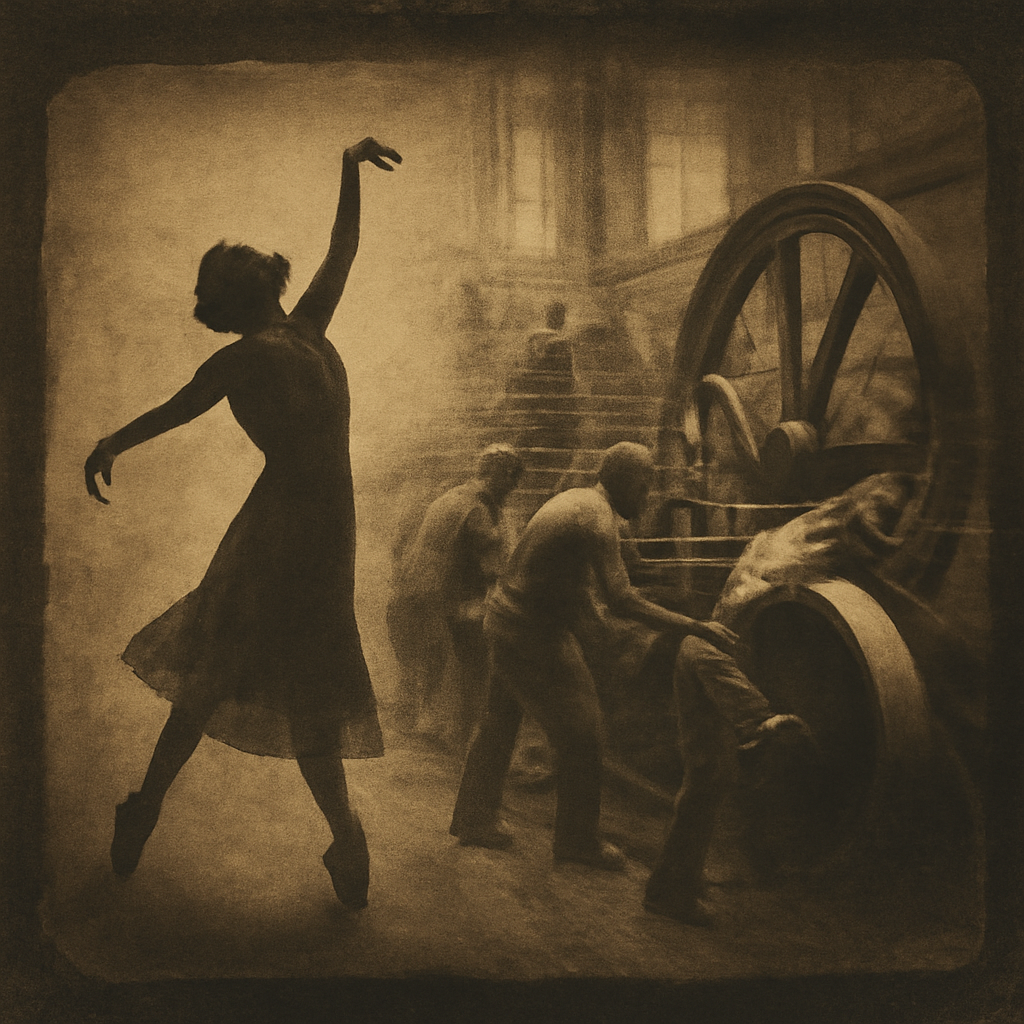
The Human Motor: How the Factory Redefined the Dance Floor
At the dawn of the twentieth century, a strange obsession took hold of the Western world. Scientists, factory owners, and artists began viewing the human body not as a temple, but as a thermodynamic engine—the human motor. In smoke-choked factories, efficiency experts tracked every twitch of a worker's arm with stopwatches. They wanted to eliminate waste. They wanted to turn flesh into perfect, tireless steel. It was a cold, mechanical vision of humanity.
Yet, this obsession did not stay confined to the assembly line. On the stage, pioneering dancers watched these same industrial rhythms. Choreographers began mapping the body's geometry, translating factory efficiency into avant-garde expression. They used the very same science of movement to liberate the body rather than enslave it. Suddenly, the assembly line and the modern dance piece were speaking the exact same language.
“The same nineteenth-century scientific obsession that turned factory workers into efficient machine parts also transformed dance from a courtly art into a disciplined study of physical efficiency.”
Reflect
If our leisure and our art are shaped by the same rules of efficiency as our work, do we ever truly escape the factory floor?
Research·2 sources·Established confidence·Investigated 5 Aug 2026(1 month ago)·Grounded; verification trace not recorded·Investigation may be outdated
Your next question, in
Visual Trail
See The Human Motor: How the Factory Redefined the Dance Floor
A guided visual explanation assembled from QE artwork and sourced documentary images.
01 / 02
QE visual interpretation
Frame 01
The Human Motor: How the Factory Redefined the Dance Floor
Modern dance and industrial factories both treated the human body as a machine, using the same science to either optimize labor or free expression.
Image provenance and limitation
Source: AI-generated visual interpretation
Creator: Question Everything
Limitation: This image explains or evokes the subject. It is not documentary evidence and should not be used to verify a factual claim.
Evidence
What do we know?
Verified claims with confidence scoring and cited sources.
1 of 3 findings need extra caution. Finding 1 rests on weaker sourcing than the other findings.
Living footnotes
Claims remain in the reading flow. Select a citation number to inspect the source behind it.
01
HistoricalNot confirmed
The 'human motor' concept applied industrial efficiency and thermodynamic laws to human body movements.
In the late nineteenth century, a new science of work emerged. Historian Anson Rabinbach details how scientists and factory owners began viewing the human body as a thermodynamic engine. They called it the 'human motor.' Through time-and-motion studies, they analyzed every muscle twitch to defeat fatigue and maximize output. This industrial discipline quickly bled out of the factories, reshaping how society viewed physical movement in everyday life, entertainment, and artistic performance.
02
ExperimentalSupported
Modern dance pedagogy relies on motor learning principles to systematically train physical efficiency and coordination.
Just as factories optimized physical labor, modern dance training evolved to systematically program the human body. Motor learning science shows that practice permanently alters the brain's internal processes to build highly specialized skills. Dancers do not just move; they train for extreme physical efficiency. By analyzing biomechanics, such as how the pelvis shifts during a balance, dancers reduce wasted energy. They turn the body into a highly coordinated, precise instrument of performance.
03
ObservationalSupported
Contemporary choreographers use industrial robots to explore the physical relationship between human bodies and automated machines.
The boundary between human worker and machine blurs on the modern stage. Choreographer Huang Yi created a duet with a KUKA industrial robot arm, programming its movements to interact with his own. By mirroring and touching the heavy industrial machine, Yi explores the emotional and physical boundaries of automated labor. This artistic dialogue shows how deeply our physical expression has become intertwined with the rigid, pre-programmed rhythms of industrial technology.
The complete record below preserves every citation, confidence input and recorded limitation.
Read the full evidence record3 findings · citations · limitations
Evidence review3 findings2 openable sources
01
Finding 1 of 3HistoricalNeeds caution
0/0 verified
The 'human motor' concept applied industrial efficiency and thermodynamic laws to human body movements.
In the late nineteenth century, a new science of work emerged. Historian Anson Rabinbach details how scientists and factory owners began viewing the human body as a thermodynamic engine. They called it the 'human motor.' Through time-and-motion studies, they analyzed every muscle twitch to defeat fatigue and maximize output. This industrial discipline quickly bled out of the factories, reshaping how society viewed physical movement in everyday life, entertainment, and artistic performance.
Not confirmedmodel score 30%
Scored as if sourced, but every citation failed verification.
NO SURVIVING CITATION
›View sources and limits— limits
Supporting passage
In the late nineteenth century, a new science of work emerged. Historian Anson Rabinbach details how scientists and factory owners began viewing the human body as a thermodynamic engine. They called it the 'human motor.' Through time-and-motion studies, they analyzed every muscle twitch to defeat fatigue and maximize output. This industrial discipline quickly bled out of the factories, reshaping how society viewed physical movement in everyday life, entertainment, and artistic performance.
Citations (0 of 1 survived verification)
Nothing openable. Every citation was removed by provenance validation.
What limits this
All 1 citation on this claim failed verification and were removed. Nothing openable supports it.
02
Finding 2 of 3Experimental
1
0/1 verified
Modern dance pedagogy relies on motor learning principles to systematically train physical efficiency and coordination.
Just as factories optimized physical labor, modern dance training evolved to systematically program the human body. Motor learning science shows that practice permanently alters the brain's internal processes to build highly specialized skills. Dancers do not just move; they train for extreme physical efficiency. By analyzing biomechanics, such as how the pelvis shifts during a balance, dancers reduce wasted energy. They turn the body into a highly coordinated, precise instrument of performance.
Supportedmodel score 90%
One source, not peer-reviewed. Thinner than the score suggests.
REFERENCE
›View sources and limits— 1 citation, limits
Supporting passage
Just as factories optimized physical labor, modern dance training evolved to systematically program the human body. Motor learning science shows that practice permanently alters the brain's internal processes to build highly specialized skills. Dancers do not just move; they train for extreme physical efficiency. By analyzing biomechanics, such as how the pelvis shifts during a balance, dancers reduce wasted energy. They turn the body into a highly coordinated, precise instrument of performance.
Rests on a single source. No independent corroboration.
No peer-reviewed source among the citations.
The generator scored this 90%, which would read as “Established”. Its citations reach only “Supported”, so that is what is shown.
03
Finding 3 of 3Observational
0/1 verified
Contemporary choreographers use industrial robots to explore the physical relationship between human bodies and automated machines.
The boundary between human worker and machine blurs on the modern stage. Choreographer Huang Yi created a duet with a KUKA industrial robot arm, programming its movements to interact with his own. By mirroring and touching the heavy industrial machine, Yi explores the emotional and physical boundaries of automated labor. This artistic dialogue shows how deeply our physical expression has become intertwined with the rigid, pre-programmed rhythms of industrial technology.
Supportedmodel score 95%
One source, not peer-reviewed. Thinner than the score suggests.
REFERENCE
›View sources and limits— 1 citation, limits
Supporting passage
The boundary between human worker and machine blurs on the modern stage. Choreographer Huang Yi created a duet with a KUKA industrial robot arm, programming its movements to interact with his own. By mirroring and touching the heavy industrial machine, Yi explores the emotional and physical boundaries of automated labor. This artistic dialogue shows how deeply our physical expression has become intertwined with the rigid, pre-programmed rhythms of industrial technology.
Rests on a single source. No independent corroboration.
No peer-reviewed source among the citations.
The generator scored this 95%, which would read as “Established”. Its citations reach only “Supported”, so that is what is shown.
Interactive Exploration
Touch, drag, and discover
These visualizations respond to your curiosity. Interact to go deeper.
process flow
Programming the Human Motor
Sensory Perception
Motor Recruitment
Feedback & Correction
Consolidation
comparison table
Two Sides of the Human Engine
Industrial Assembly Line
Modern Dance Performance
Primary Objective
Economic output and material production
Aesthetic expression and physical communication
Movement Philosophy
Elimination of variation to ensure uniformity
Mastery of variation to express emotion
Relationship to Fatigue
A limit to be overcome by scientific management
A physical boundary explored through choreography
Control Mechanism
External factory clocks and assembly speeds
Internalized rhythm and choreographic cues
Tap any row to highlight and compare
Perspectives
How is this interpreted?
Enter a viewpoint. Notice what it reveals, what it leaves out, and whether it changes the question for you.
The EmpiricistScientific viewpointEstablished lens
The body is an engine bound by thermodynamics and motor control. From this perspective, dance and industrial labor are virtually identical. Both require the brain to program motor pathways, minimizing energy waste while maximizing physical output. Whether assembling a car or performing a pirouette, the human motor relies on the same physiological mechanisms of muscle recruitment, feedback loops, and energy conservation. It is all about biomechanical efficiency.
What this lens notices
01The body obeys the laws of thermodynamics.
02Motor learning permanently changes brain pathways for efficiency.
03Both tasks require minimizing physical fatigue.
Application
Why does this matter to you?
Personal reflections and applications for your life.
Thought experimentSelf-Reflection
How often do you evaluate your daily movements by their productivity?
Why it changes the question
We often treat our bodies like machines, optimizing our schedules and steps for maximum output. Recognizing this 'human motor' mindset helps us appreciate movement for pure joy, rather than utility.
Try this
Spend ten minutes moving your body with absolutely no goal or purpose, resisting the urge to track it on a device.
Media
QE Smart Glass
Curated media selected for this investigation.
QE Glass
YOUTUBE
The Most Misunderstood Concept in Physics
Veritasium
One of the most important, yet least understood, concepts in all of physics. Head to https://brilliant.org/veritasium to start your free ...
QE Glass
YOUTUBE
How your muscular system works - Emma Bryce
TED-Ed
Check out our Patreon page: https://www.patreon.com/teded View full lesson: ...
QE Glass
YOUTUBE
Why humans love to bust a move | Dance, Dance Evolution
Aeon Video
Dance seems to be the ultimate frivolity. How did it become a human necessity? Watch 'Dance, Dance Evolution' on Aeon: ...
QE Glass
YOUTUBE
Erikson’s 8 Stages of Psychosocial Development Explained
Sprouts
Erikson's theory of psychosocial development identifies eight stages in which a healthy individual should pass through from birth ...
QE Glass
YOUTUBE
Machine Learning | What Is Machine Learning? | Introduction To Machine Learning | 2026 | Simplilearn
Simplilearn
" Michigan Engineering Professional Certificate in AI and Machine Learning ...
QE Glass
YOUTUBE
SOCIOLOGY - Émile Durkheim
The School of Life
Emile Durkheim was a French 19th century sociologist who focused on what modern capitalism does to our minds - and ...
QE Glass
YOUTUBE
HUANG YI & KUKA A DUET OF HUMAN AND ROBOT
DanceinAmerica
QE Glass
PODCAST
The History of Fatigue and the Science of Work
BBC Radio 4 - In Our Time
An exploration of how nineteenth-century science redefined the human body as an energy-conserving motor, shifting our entire relationship with labor and rest.
Connected context
Connected entities
The people, places, concepts, and events that matter here.
Keep Going
Where this leads
Questions this investigation opens up — and what QE has already looked into.
No AI help here — no suggestions, no autocomplete, nothing finishing your sentences. That is deliberate. Working out what you think is effortful, and the effort is the part that changes you: reasoning is trained like a muscle, and a muscle that is always carried gets weaker. Let something else do the thinking and you keep the answer but lose the capacity to have reached it.
Write your current position.
Not what the page says. What you think, having read it.0 words · Nothing written yet.
Sign in to leave a mark. Your draft is saved here in the meantime.