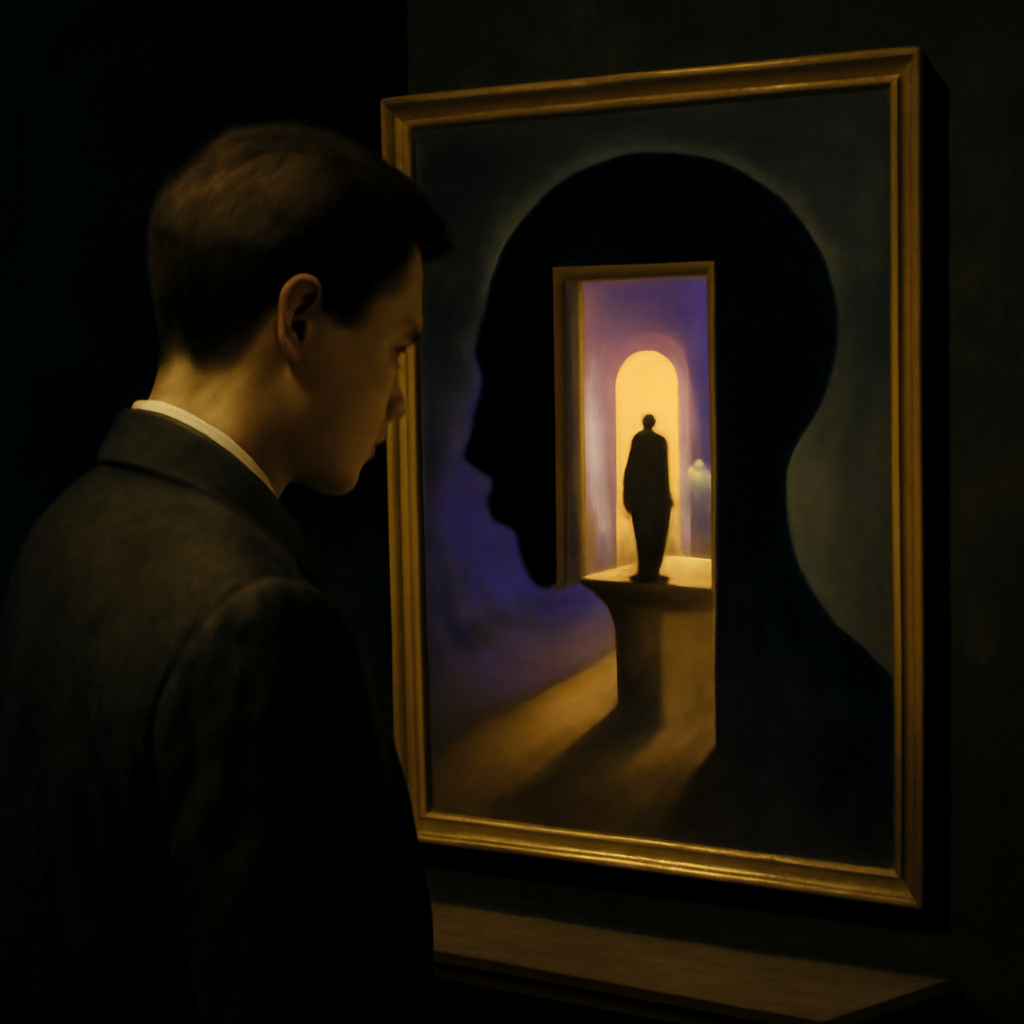
The Enigma of Being: Unraveling the Science of Consciousness
From the first flicker of self-awareness in a child's eyes to the profound contemplations of a philosopher, consciousness remains humanity's most intimate and confounding mystery. It is the very essence of 'being,' the subjective experience that paints our world with qualia – the redness of red, the taste of chocolate, the ache of loss. Yet, despite centuries of inquiry and unprecedented advances in neuroscience, science grapples with a fundamental paradox: how does the intricate machinery of the brain give rise to this ethereal, inner world? We can map brain activity, track neural pathways, and even manipulate perception, but the leap from electrochemical signals to subjective experience – the 'hard problem' – remains an impenetrable frontier.
This exploration delves into the scientific quests to define, localize, and understand consciousness, even as the ultimate 'what it is' eludes full grasp. We'll navigate the leading theories, examine the neural correlates that hint at its physical basis, and confront the profound philosophical questions it poses. By piecing together fragments of understanding from neuroscience, psychology, and philosophy, we aim to illuminate the edges of this vast unknown, revealing not just what we know, but the breathtaking complexity of what we are still striving to comprehend about our own existence.
✨
Wonder Moment
“Every individual moment of conscious experience is an intricate orchestration of billions of neurons and trillions of connections, yet the 'orchestra conductor' – the unifying subjective 'I' – remains the universe's most profound and intimate illusion.”
Reflect
If consciousness can emerge from sufficiently complex systems, could entire planets, galaxies, or even the universe itself possess a form of awareness beyond our comprehension?
5 sources·Established confidence·Investigated 19 Jun 2026(2 months ago)·Investigation may be outdated
Your next question, in
Visual Trail
See The Enigma of Being: Unraveling the Science of Consciousness
A guided visual explanation assembled from QE artwork and sourced documentary images.
01 / 02
QE visual interpretation
Frame 01
The Enigma of Being: Unraveling the Science of Consciousness
Consciousness: humanity's greatest mystery, born from the brain, yet transcending mere biology – how does science approach this profound enigma?
Image provenance and limitation
Source: AI-generated visual interpretation
Creator: Question Everything
Limitation: This image explains or evokes the subject. It is not documentary evidence and should not be used to verify a factual claim.
Evidence
What do we know?
Verified claims with confidence scoring and cited sources.
Generated without source retrieval. QE did not fetch sources for this investigation, so no citation here was checked against a retrieved set. Claims reflect the model’s training data.
Living footnotes
Claims remain in the reading flow. Select a citation number to inspect the source behind it.
01
ExperimentalSupported
The 'Neural Correlates of Consciousness' (NCCs) identify specific patterns of brain activity that consistently accompany conscious experience.
Scientists actively search for NCCs: the minimal neuronal mechanisms jointly sufficient for any one specific conscious percept. This involves observing brain activity using techniques like fMRI and EEG while a person experiences different conscious states or perceptions. For example, researchers might present ambiguous images, where the brain receives constant sensory input, but the conscious perception switches between two interpretations. The differing brain activity observed during these perceptual switches, despite constant input, is a strong candidate for an NCC. While NCCs don't explain *how* subjective experience arises, they pinpoint *where and when* it correlates with physical brain processes, providing crucial empirical anchors for theories of consciousness.
Key areas of focus include activity in the prefrontal cortex, parietal cortex, and specific thalamic nuclei. The idea is that understanding these correlates can help differentiate conscious processing from unconscious processing, even if the 'why' and 'how' of subjective experience (qualia) remain elusive. Research on NCCs is foundational for building and testing more comprehensive theories of consciousness.
02
AcademicSupported
Integrated Information Theory (IIT) proposes that consciousness is identical to integrated information, a quantity ('phi') that measures the amount of irreducible cause-effect power in a system.
Developed by Giulio Tononi and collaborators, IIT attempts to provide a fundamental account of what consciousness *is* and how it can be measured. It posits that a system is conscious if it has a large repertoire of states (information) and if these states are highly interconnected and mutually dependent (integrated). The theory suggests that consciousness is not merely about having information, but about the *integration* of that information into a unified, irreducible whole that cannot be broken down into independent components.
IIT offers specific postulates, such as consciousness being intrinsic (existing for itself), structured (composed of distinctions), and specific (each experience is unique). While mathematically complex and still under active development and debate, IIT provides a framework for both identifying conscious systems (even non-biological ones) and for understanding the level and nature of their consciousness. It suggests that consciousness is a fundamental property of specific physical systems that meet certain informational criteria, rather than an emergent property of computation alone.
03
AcademicSupported
The Global Neuronal Workspace Theory (GNWT) suggests that consciousness arises when information becomes globally available throughout the brain, allowing for widespread access and broadcasting of specific contents.
Proposed by Bernard Baars and further developed by Stanislas Dehaene, GNWT focuses on the functional aspect of consciousness. It posits that the brain acts like a 'workspace' where a limited amount of information can be temporarily made globally accessible to a multitude of specialized unconscious processors (e.g., memory, attention, motor control). When information enters this global workspace, it becomes conscious.
According to GNWT, unconscious processes are localized and specialized, operating in parallel. Consciousness, however, is characterized by a serial processing bottleneck where a single 'thought' or perception is broadcast across the brain, influencing various cognitive functions. This theory explains why we can only consciously focus on a few things at once and how conscious awareness allows for flexible, novel behaviors, unlike the rigid, automatic responses of unconscious processes. It offers a compelling framework for understanding the functional role of consciousness in cognition and behavior, distinguishing it from purely unconscious brain activity.
04
ObservationalSupported
Philosopher David Chalmers distinguishes between 'easy problems' of consciousness, which relate to cognitive functions, and the 'hard problem,' which asks how physical processes give rise to subjective experience (qualia).
Chalmers' distinction is crucial for understanding the current impasse in consciousness research. The 'easy problems' include explaining phenomena like wakefulness, attention, learning, memory, and the ability to report mental states. These are functionally defined and, while complex, seem amenable to conventional scientific investigation through neuroscience and cognitive psychology.
However, the 'hard problem' is qualitatively different. It's the question of *why* and *how* any physical process should give rise to subjective, inner experience – the 'what it's like' aspect of consciousness. Why isn't a brain just an elaborate machine processing information without any inner feeling? This problem highlights the explanatory gap between objective physical descriptions and subjective phenomenal experience, challenging purely materialist explanations and prompting diverse philosophical and scientific responses.
The complete record below preserves every citation, confidence input and recorded limitation.
Read the full evidence record4 findings · citations · limitations
Evidence review4 findings5 openable sources
01
Finding 1 of 4Experimental
1
0/1 verified
The 'Neural Correlates of Consciousness' (NCCs) identify specific patterns of brain activity that consistently accompany conscious experience.
Scientists actively search for NCCs: the minimal neuronal mechanisms jointly sufficient for any one specific conscious percept. This involves observing brain activity using techniques like fMRI and EEG while a person experiences different conscious states or perceptions. For example, researchers might present ambiguous images, where the brain receives constant sensory input, but the conscious perception switches between two interpretations. The differing brain activity observed during these perceptual switches, despite constant input, is a strong candidate for an NCC. While NCCs don't explain *how* subjective experience arises, they pinpoint *where and when* it correlates with physical brain processes, providing crucial empirical anchors for theories of consciousness.
Key areas of focus include activity in the prefrontal cortex, parietal cortex, and specific thalamic nuclei. The idea is that understanding these correlates can help differentiate conscious processing from unconscious processing, even if the 'why' and 'how' of subjective experience (qualia) remain elusive. Research on NCCs is foundational for building and testing more comprehensive theories of consciousness.
Supportedmodel score 90%
A single peer-reviewed source. No independent corroboration.
PRIMARY STUDY
›View sources and limits— 1 citation, limits
Supporting passage
Scientists actively search for NCCs: the minimal neuronal mechanisms jointly sufficient for any one specific conscious percept. This involves observing brain activity using techniques like fMRI and EEG while a person experiences different conscious states or perceptions. For example, researchers might present ambiguous images, where the brain receives constant sensory input, but the conscious perception switches between two interpretations. The differing brain activity observed during these perceptual switches, despite constant input, is a strong candidate for an NCC. While NCCs don't explain *how* subjective experience arises, they pinpoint *where and when* it correlates with physical brain processes, providing crucial empirical anchors for theories of consciousness.
Key areas of focus include activity in the prefrontal cortex, parietal cortex, and specific thalamic nuclei. The idea is that understanding these correlates can help differentiate conscious processing from unconscious processing, even if the 'why' and 'how' of subjective experience (qualia) remain elusive. Research on NCCs is foundational for building and testing more comprehensive theories of consciousness.
Generated without source retrieval — citations here were not verified against a retrieved set.
1 of 2 citations failed verification and are not shown.
Rests on a single source. No independent corroboration.
The generator scored this 90%, which would read as “Established”. Its citations reach only “Supported”, so that is what is shown.
02
Finding 2 of 4Academic
2
0/2 verified
Integrated Information Theory (IIT) proposes that consciousness is identical to integrated information, a quantity ('phi') that measures the amount of irreducible cause-effect power in a system.
Developed by Giulio Tononi and collaborators, IIT attempts to provide a fundamental account of what consciousness *is* and how it can be measured. It posits that a system is conscious if it has a large repertoire of states (information) and if these states are highly interconnected and mutually dependent (integrated). The theory suggests that consciousness is not merely about having information, but about the *integration* of that information into a unified, irreducible whole that cannot be broken down into independent components.
IIT offers specific postulates, such as consciousness being intrinsic (existing for itself), structured (composed of distinctions), and specific (each experience is unique). While mathematically complex and still under active development and debate, IIT provides a framework for both identifying conscious systems (even non-biological ones) and for understanding the level and nature of their consciousness. It suggests that consciousness is a fundamental property of specific physical systems that meet certain informational criteria, rather than an emergent property of computation alone.
Supportedmodel score 80%
2 sources agree, 1 peer-reviewed.
PRIMARY STUDYREFERENCE
›View sources and limits— 2 citations, limits
Supporting passage
Developed by Giulio Tononi and collaborators, IIT attempts to provide a fundamental account of what consciousness *is* and how it can be measured. It posits that a system is conscious if it has a large repertoire of states (information) and if these states are highly interconnected and mutually dependent (integrated). The theory suggests that consciousness is not merely about having information, but about the *integration* of that information into a unified, irreducible whole that cannot be broken down into independent components.
IIT offers specific postulates, such as consciousness being intrinsic (existing for itself), structured (composed of distinctions), and specific (each experience is unique). While mathematically complex and still under active development and debate, IIT provides a framework for both identifying conscious systems (even non-biological ones) and for understanding the level and nature of their consciousness. It suggests that consciousness is a fundamental property of specific physical systems that meet certain informational criteria, rather than an emergent property of computation alone.
Generated without source retrieval — citations here were not verified against a retrieved set.
03
Finding 3 of 4Academic
1
0/1 verified
The Global Neuronal Workspace Theory (GNWT) suggests that consciousness arises when information becomes globally available throughout the brain, allowing for widespread access and broadcasting of specific contents.
Proposed by Bernard Baars and further developed by Stanislas Dehaene, GNWT focuses on the functional aspect of consciousness. It posits that the brain acts like a 'workspace' where a limited amount of information can be temporarily made globally accessible to a multitude of specialized unconscious processors (e.g., memory, attention, motor control). When information enters this global workspace, it becomes conscious.
According to GNWT, unconscious processes are localized and specialized, operating in parallel. Consciousness, however, is characterized by a serial processing bottleneck where a single 'thought' or perception is broadcast across the brain, influencing various cognitive functions. This theory explains why we can only consciously focus on a few things at once and how conscious awareness allows for flexible, novel behaviors, unlike the rigid, automatic responses of unconscious processes. It offers a compelling framework for understanding the functional role of consciousness in cognition and behavior, distinguishing it from purely unconscious brain activity.
Supportedmodel score 85%
A single peer-reviewed source. No independent corroboration.
PRIMARY STUDY
›View sources and limits— 1 citation, limits
Supporting passage
Proposed by Bernard Baars and further developed by Stanislas Dehaene, GNWT focuses on the functional aspect of consciousness. It posits that the brain acts like a 'workspace' where a limited amount of information can be temporarily made globally accessible to a multitude of specialized unconscious processors (e.g., memory, attention, motor control). When information enters this global workspace, it becomes conscious.
According to GNWT, unconscious processes are localized and specialized, operating in parallel. Consciousness, however, is characterized by a serial processing bottleneck where a single 'thought' or perception is broadcast across the brain, influencing various cognitive functions. This theory explains why we can only consciously focus on a few things at once and how conscious awareness allows for flexible, novel behaviors, unlike the rigid, automatic responses of unconscious processes. It offers a compelling framework for understanding the functional role of consciousness in cognition and behavior, distinguishing it from purely unconscious brain activity.
Generated without source retrieval — citations here were not verified against a retrieved set.
1 of 2 citations failed verification and are not shown.
Rests on a single source. No independent corroboration.
The generator scored this 85%, which would read as “Established”. Its citations reach only “Supported”, so that is what is shown.
04
Finding 4 of 4Observational
0/1 verified
Philosopher David Chalmers distinguishes between 'easy problems' of consciousness, which relate to cognitive functions, and the 'hard problem,' which asks how physical processes give rise to subjective experience (qualia).
Chalmers' distinction is crucial for understanding the current impasse in consciousness research. The 'easy problems' include explaining phenomena like wakefulness, attention, learning, memory, and the ability to report mental states. These are functionally defined and, while complex, seem amenable to conventional scientific investigation through neuroscience and cognitive psychology.
However, the 'hard problem' is qualitatively different. It's the question of *why* and *how* any physical process should give rise to subjective, inner experience – the 'what it's like' aspect of consciousness. Why isn't a brain just an elaborate machine processing information without any inner feeling? This problem highlights the explanatory gap between objective physical descriptions and subjective phenomenal experience, challenging purely materialist explanations and prompting diverse philosophical and scientific responses.
Supportedmodel score 95%
One source, not peer-reviewed. Thinner than the score suggests.
REFERENCE
›View sources and limits— 1 citation, limits
Supporting passage
Chalmers' distinction is crucial for understanding the current impasse in consciousness research. The 'easy problems' include explaining phenomena like wakefulness, attention, learning, memory, and the ability to report mental states. These are functionally defined and, while complex, seem amenable to conventional scientific investigation through neuroscience and cognitive psychology.
However, the 'hard problem' is qualitatively different. It's the question of *why* and *how* any physical process should give rise to subjective, inner experience – the 'what it's like' aspect of consciousness. Why isn't a brain just an elaborate machine processing information without any inner feeling? This problem highlights the explanatory gap between objective physical descriptions and subjective phenomenal experience, challenging purely materialist explanations and prompting diverse philosophical and scientific responses.
Philosophical debate, theoretical physics, integrated information theories
Current Status
Significant progress, actively being solved
Largely unresolved, deep explanatory gap
Tap any row to highlight and compare
statistics card
The Brain's Complexity
86 Billion
Neurons
The estimated number of neurons in the average human brain, each capable of complex computations.
100 Trillion
Synaptic Connections
The approximate number of connections between neurons, forming an incredibly intricate network for information flow.
20 Watts
Power Consumption
The approximate power consumed by the brain, highlighting its energy efficiency despite immense complexity.
spectrum
Spectrum of Philosophical Views on Consciousness
Materialism/Physicalism (Mind is Brain)Dualism/Idealism (Mind is separate/primary)
5%
Eliminative Materialism
30%
Emergent Materialism
50%
Panpsychism
75%
Substance Dualism
95%
Idealism
relationship map
Key Concepts Intersecting with Consciousness
Mapping relationships…
Drag nodes to rearrange — tap for details
Perspectives
How is this interpreted?
Enter a viewpoint. Notice what it reveals, what it leaves out, and whether it changes the question for you.
The EmpiricistScientific viewpointLive tension
From a scientific materialist perspective, consciousness is an emergent property of complex neural networks in the brain. It is not something 'other' than the brain, but rather what the brain *does* at a certain level of organizational complexity. Neuroscientists and cognitive scientists largely operate under the assumption that a complete understanding of brain function will eventually lead to an understanding of consciousness, even if the 'hard problem' remains a significant hurdle. They focus on identifying the specific neural mechanisms (NCCs), cognitive architectures (GNWT), or informational properties (IIT) that give rise to conscious states.
This viewpoint often emphasizes the incremental progress being made in mapping brain function, understanding neural plasticity, and decoding sensory perception. The belief is that continued empirical research, combined with refined theoretical models, will gradually close the explanatory gap. While acknowledging the difficulty, proponents of this view maintain an optimistic outlook that consciousness is a phenomenon ultimately explainable within the framework of physical science.
What this lens notices
01Consistent identification of Neural Correlates of Consciousness (NCCs).
02Progress in understanding specific cognitive functions like attention and memory.
03Evolutionary perspective: consciousness as an adaptive trait enhancing survival.
Application
Why does this matter to you?
Personal reflections and applications for your life.
Thought experimentSelf-Reflection
How does your personal experience of consciousness shape your understanding of the world and your place within it?
Why it changes the question
Understanding that consciousness is still largely a mystery can profoundly shift one's perspective. It highlights the uniqueness of individual experience and the subjective nature of reality. Reflecting on your own 'qualia' – the specific way you perceive colors, sounds, and emotions – can foster a deeper appreciation for the intricate, personalized lens through which you interact with existence. This can lead to greater empathy for others, acknowledging that their inner worlds, while unobservable, are just as real and complex as your own.
Try this
Practice a mindful observation exercise: for five minutes, pay close attention to a single sensory experience (e.g., the taste of a piece of fruit, the sound of rain). Notice the subtle nuances and the subjective 'feel' of the experience, trying to separate the pure sensation from your interpretation or thoughts about it.
Media
QE Smart Glass
Curated media selected for this investigation.
QE Glass
YOUTUBE
What Is Consciousness?
Vsauce
LEANBACK IS HERE: http://www.youtube.com/watch?v=JoR0bMohcNo&list=PLE3048008DAA29B0A&feature=plpp_play_all ...
QE Glass
YOUTUBE
Is there consciousness beyond the brain? | Philip Goff | TEDxNewEngland
TEDx Talks
What if consciousness isn't a mysterious aspect of the universe—but its very foundation? In this thought-provoking talk, ...
QE Glass
YOUTUBE
Why Your Brain Blinds You For 2 Hours Every Day
Kurzgesagt – In a Nutshell
Go to https://brilliant.org/nutshell/ to dive deeper into these topics and more with a free 30-day trial + 20% off the premium ...
QE Glass
YOUTUBE
You aren't at the mercy of your emotions -- your brain creates them | Lisa Feldman Barrett
TED
Can you look at someone's face and know what they're feeling? Does everyone experience happiness, sadness and anxiety the ...
QE Glass
YOUTUBE
Can you "see" images in your mind? Some people can't - Adam Zeman
TED-Ed
Learn more at https://brilliant.org/TedEd -- When reading "Alice's Adventures in Wonderland," most readers visualize the queen's ...
QE Glass
YOUTUBE
Does time exist? - Andrew Zimmerman Jones
TED-Ed
Download a free audiobook version of "A Brief History of Time" and support TED-Ed's nonprofit mission: https://adbl.co/2NWYjAh ...
QE Glass
YOUTUBE
What Is Consciousness?
Vsauce
LEANBACK IS HERE: http://www.youtube.com/watch?v=JoR0bMohcNo&list=PLE3048008DAA29B0A&feature=plpp_play_all ...
QE Glass
YOUTUBE
Consciousness and the Brain 2/7
Overthink Podcast
... discusses Stanislas Dehaene's book Consciousness and the Brain: Deciphering How the Brain Codes Our Thoughts, focusing ...
QE Glass
PODCAST
Colors
Radiolab
A fascinating episode exploring the subjective nature of color perception (qualia) and how different beings might experience the world.
QE Glass
PODCAST
The Nature of Consciousness
Making Sense with Sam Harris
Philosopher and neuroscientist Sam Harris often hosts discussions on consciousness, meditation, and the self, offering deep dives into the philosophical implications.
Keep Going
Where this leads
Questions this investigation opens up — and what QE has already looked into.
No AI help here — no suggestions, no autocomplete, nothing finishing your sentences. That is deliberate. Working out what you think is effortful, and the effort is the part that changes you: reasoning is trained like a muscle, and a muscle that is always carried gets weaker. Let something else do the thinking and you keep the answer but lose the capacity to have reached it.
Write your current position.
Not what the page says. What you think, having read it.0 words · Nothing written yet.
Sign in to leave a mark. Your draft is saved here in the meantime.