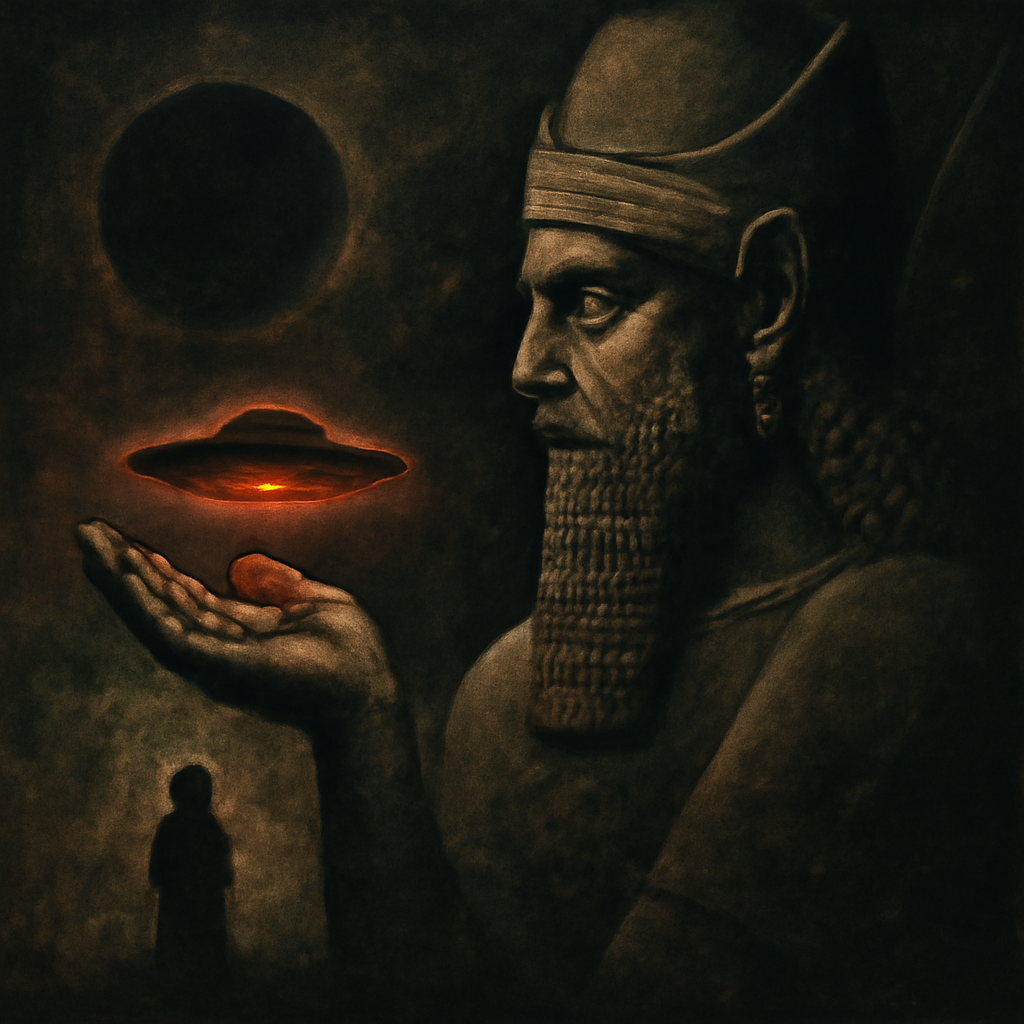
The Anunnaki are a group of deities that appear in the ancient stories of Mesopotamia, a region that is now mostly Iraq. These gods were said to be powerful beings who controlled the world and shaped human destiny. The name 'Anunnaki' means something like 'those who came from the heavens' or 'princely offspring.' In old Sumerian, Akkadian, and Babylonian myths, they formed a council of gods who decided the fate of humans and the earth. People long ago believed these beings were responsible for creating humans and managing natural forces.
Over time, the Anunnaki turned into a topic of fascination far beyond old texts. Some modern writers and conspiracy theories claim they were actually ancient astronauts — aliens who visited Earth and helped early people build civilization. These ideas mix old myths with science fiction, sparking debates about history and truth. But most scholars agree the Anunnaki were ancient gods, part of stories people told to explain the world around them.
Today, the Anunnaki still capture imaginations. They remind us how humans have always looked to the stars and told stories about powerful beings shaping life. Whether as gods or aliens, the Anunnaki show how myth and mystery can blend across time, inspiring questions about where we come from and who watches over us.
“The Anunnaki are some of the oldest gods ever recorded, shaping stories that survived over 4,000 years.”
Reflect
If ancient humans invented gods to explain the sky and life, what stories are we creating today that future generations might believe as truth?
Research·Developing confidence·Investigated 16 Jul 2026(2 months ago)·Investigation may be outdated
Your next question, in
Visual Trail
See The Anunnaki: Ancient Gods and Modern Mysteries
A guided visual explanation assembled from QE artwork and sourced documentary images.
01 / 02
QE visual interpretation
Frame 01
The Anunnaki: Ancient Gods and Modern Mysteries
The Anunnaki are ancient Mesopotamian gods who shaped human stories and inspired modern alien theories.
Image provenance and limitation
Source: AI-generated visual interpretation
Creator: Question Everything
Limitation: This image explains or evokes the subject. It is not documentary evidence and should not be used to verify a factual claim.
Evidence
What do we know?
Verified claims with confidence scoring and cited sources.
Generated without source retrieval. QE did not fetch sources for this investigation, so no citation here was checked against a retrieved set. Claims reflect the model’s training data. 4 of 4 findings carry no openable link at all.
Living footnotes
Claims remain in the reading flow. Select a citation number to inspect the source behind it.
01
HistoricalNot confirmed
The Anunnaki were a group of gods in ancient Mesopotamian mythology.
Ancient texts from Sumer, Akkad, and Babylon mention the Anunnaki as powerful gods who played key roles in creation stories and the governance of the universe. They were seen as judges and rulers who controlled fate and natural forces. The word 'Anunnaki' appears in several myths, such as the Epic of Gilgamesh and the Enuma Elish, showing their importance in Mesopotamian religion.
02
AcademicNot confirmed
The name 'Anunnaki' means 'those who came from the heavens' or 'princely offspring.'
The term 'Anunnaki' comes from ancient Sumerian language roots: 'An' meaning sky or heaven, and 'naki' meaning offspring or descendants. This suggests these gods were considered children of the sky god Anu, highlighting their divine origin and status. This name shows how the ancient people connected their gods directly to the heavens above.
03
ObservationalNot confirmed
Some modern theories claim the Anunnaki were ancient astronauts who influenced early human civilization.
In the 20th century, some authors proposed the idea that the Anunnaki were not just gods but extraterrestrial visitors. This theory suggests these beings came from another planet and helped humans develop technology and society. While popular in some circles, this idea lacks solid evidence and is not accepted by mainstream historians or archaeologists.
04
HistoricalNot confirmed
The Anunnaki appeared as judges and rulers in Mesopotamian myths, deciding human fate.
In stories like the Epic of Gilgamesh, the Anunnaki are shown as a council of gods who judge humans and decide important matters like life and death or natural disasters. They weren’t just creators but also enforcers of divine laws. This role gives insight into how ancient societies viewed justice and order as coming from higher powers.
The complete record below preserves every citation, confidence input and recorded limitation.
Read the full evidence record4 findings · citations · limitations
Evidence review4 findings0 openable sources
01
Finding 1 of 4Historical
0/0 verified
The Anunnaki were a group of gods in ancient Mesopotamian mythology.
Ancient texts from Sumer, Akkad, and Babylon mention the Anunnaki as powerful gods who played key roles in creation stories and the governance of the universe. They were seen as judges and rulers who controlled fate and natural forces. The word 'Anunnaki' appears in several myths, such as the Epic of Gilgamesh and the Enuma Elish, showing their importance in Mesopotamian religion.
Not confirmedmodel score 95%
Written from the model's own knowledge. No source was retrieved or checked.
UNVERIFIED — NO RETRIEVAL
›View sources and limits— limits
Supporting passage
Ancient texts from Sumer, Akkad, and Babylon mention the Anunnaki as powerful gods who played key roles in creation stories and the governance of the universe. They were seen as judges and rulers who controlled fate and natural forces. The word 'Anunnaki' appears in several myths, such as the Epic of Gilgamesh and the Enuma Elish, showing their importance in Mesopotamian religion.
Citations (0 of 2 survived verification)
Nothing openable. No sources were retrieved for this investigation, so none were checked.
What limits this
This investigation was generated without source retrieval. The model named a source but gave no link, and no verification step ran against it.
The claim reflects the model's training data, not a checked citation.
The generator scored this 95%, which would read as “Established”. Its citations reach only “Unresolved”, so that is what is shown.
02
Finding 2 of 4Academic
0
0/0 verified
The name 'Anunnaki' means 'those who came from the heavens' or 'princely offspring.'
The term 'Anunnaki' comes from ancient Sumerian language roots: 'An' meaning sky or heaven, and 'naki' meaning offspring or descendants. This suggests these gods were considered children of the sky god Anu, highlighting their divine origin and status. This name shows how the ancient people connected their gods directly to the heavens above.
Not confirmedmodel score 90%
Written from the model's own knowledge. No source was retrieved or checked.
UNVERIFIED — NO RETRIEVAL
›View sources and limits— limits
Supporting passage
The term 'Anunnaki' comes from ancient Sumerian language roots: 'An' meaning sky or heaven, and 'naki' meaning offspring or descendants. This suggests these gods were considered children of the sky god Anu, highlighting their divine origin and status. This name shows how the ancient people connected their gods directly to the heavens above.
Citations (0 of 1 survived verification)
Nothing openable. No sources were retrieved for this investigation, so none were checked.
What limits this
This investigation was generated without source retrieval. The model named a source but gave no link, and no verification step ran against it.
The claim reflects the model's training data, not a checked citation.
The generator scored this 90%, which would read as “Established”. Its citations reach only “Unresolved”, so that is what is shown.
03
Finding 3 of 4Observational
0/0 verified
Some modern theories claim the Anunnaki were ancient astronauts who influenced early human civilization.
In the 20th century, some authors proposed the idea that the Anunnaki were not just gods but extraterrestrial visitors. This theory suggests these beings came from another planet and helped humans develop technology and society. While popular in some circles, this idea lacks solid evidence and is not accepted by mainstream historians or archaeologists.
Not confirmedmodel score 40%
Written from the model's own knowledge. No source was retrieved or checked.
UNVERIFIED — NO RETRIEVAL
›View sources and limits— limits
Supporting passage
In the 20th century, some authors proposed the idea that the Anunnaki were not just gods but extraterrestrial visitors. This theory suggests these beings came from another planet and helped humans develop technology and society. While popular in some circles, this idea lacks solid evidence and is not accepted by mainstream historians or archaeologists.
Citations (0 of 2 survived verification)
Nothing openable. No sources were retrieved for this investigation, so none were checked.
What limits this
This investigation was generated without source retrieval. The model named a source but gave no link, and no verification step ran against it.
The claim reflects the model's training data, not a checked citation.
The generator scored this 40%, which would read as “Disputed”. Its citations reach only “Unresolved”, so that is what is shown.
04
Finding 4 of 4Historical
0/0 verified
The Anunnaki appeared as judges and rulers in Mesopotamian myths, deciding human fate.
In stories like the Epic of Gilgamesh, the Anunnaki are shown as a council of gods who judge humans and decide important matters like life and death or natural disasters. They weren’t just creators but also enforcers of divine laws. This role gives insight into how ancient societies viewed justice and order as coming from higher powers.
Not confirmedmodel score 90%
Written from the model's own knowledge. No source was retrieved or checked.
UNVERIFIED — NO RETRIEVAL
›View sources and limits— limits
Supporting passage
In stories like the Epic of Gilgamesh, the Anunnaki are shown as a council of gods who judge humans and decide important matters like life and death or natural disasters. They weren’t just creators but also enforcers of divine laws. This role gives insight into how ancient societies viewed justice and order as coming from higher powers.
Citations (0 of 1 survived verification)
Nothing openable. No sources were retrieved for this investigation, so none were checked.
What limits this
This investigation was generated without source retrieval. The model named a source but gave no link, and no verification step ran against it.
The claim reflects the model's training data, not a checked citation.
The generator scored this 90%, which would read as “Established”. Its citations reach only “Unresolved”, so that is what is shown.
Interactive Exploration
Touch, drag, and discover
These visualizations respond to your curiosity. Interact to go deeper.
timeline
Key Moments in Anunnaki Mythology
Loading timeline…
relationship map
The Anunnaki and Related Concepts
Mapping relationships…
Drag nodes to rearrange — tap for details
comparison table
Gods vs. Aliens: Views on the Anunnaki
Ancient Gods
Ancient Aliens
Origin
Mythological beings from heaven
Extraterrestrial visitors
Role
Creators and rulers in myths
Helpers of early human tech
Evidence
Ancient texts and artifacts
Speculative without proof
Acceptance
Widely accepted by historians
Rejected by mainstream science
Tap any row to highlight and compare
statistics card
Why the Anunnaki Still Matter
4000+ years
Age of earliest Anunnaki myths
Shows their place as some of the oldest stories in human history.
Thousands
Number of cuneiform tablets referencing Anunnaki
Reflects their importance in ancient Mesopotamian religion.
Millions
People interested in Anunnaki and ancient aliens today
Demonstrates ongoing fascination and cultural impact.
Perspectives
How is this interpreted?
Enter a viewpoint. Notice what it reveals, what it leaves out, and whether it changes the question for you.
The EmpiricistScientific viewpointEstablished lens
From a scientific viewpoint, the Anunnaki are part of ancient mythology, not real beings. Archaeologists and historians study the stories and artifacts to understand how early humans explained their world and lives. The myths reflect human culture, fears, hopes, and the desire to explain natural events like floods or the seasons. There is no credible evidence that the Anunnaki were actual extraterrestrials.
What this lens notices
01Ancient texts place the Anunnaki firmly in mythology.
03Cultural context explains the gods as symbolic figures.
Application
Why does this matter to you?
Personal reflections and applications for your life.
Thought experimentSelf-Reflection
How do the stories we tell shape our understanding of the world?
Why it changes the question
Like the Anunnaki myths, our own stories and beliefs influence how we see reality. Reflecting on this can help us question what we accept as truth and open up to new ideas.
Try this
Try writing down a personal story or belief you hold and think about where it might have come from or how it affects your life.
Media
QE Smart Glass
Curated media selected for this investigation.
QE Glass
YOUTUBE
Who Were the Anunnaki? | Ancient History Documentary
Ancient Architects
A clear and engaging video explaining the origins and myths about the Anunnaki.
QE Glass
YOUTUBE
Ancient Aliens - The Anunnaki Explained
History Channel
Looks at the popular ancient astronaut theory involving the Anunnaki.
QE Glass
PODCAST
Myths and Legends: The Anunnaki
Stuff You Should Know
A podcast episode discussing Mesopotamian gods including the Anunnaki.
QE Glass
YOUTUBE
The Epic of Gilgamesh - Animated Summary
TED-Ed
An animated video summarizing the Epic of Gilgamesh where Anunnaki appear.
Keep Going
Where this leads
Questions this investigation opens up — and what QE has already looked into.
No AI help here — no suggestions, no autocomplete, nothing finishing your sentences. That is deliberate. Working out what you think is effortful, and the effort is the part that changes you: reasoning is trained like a muscle, and a muscle that is always carried gets weaker. Let something else do the thinking and you keep the answer but lose the capacity to have reached it.
Write your current position.
Not what the page says. What you think, having read it.0 words · Nothing written yet.
Sign in to leave a mark. Your draft is saved here in the meantime.