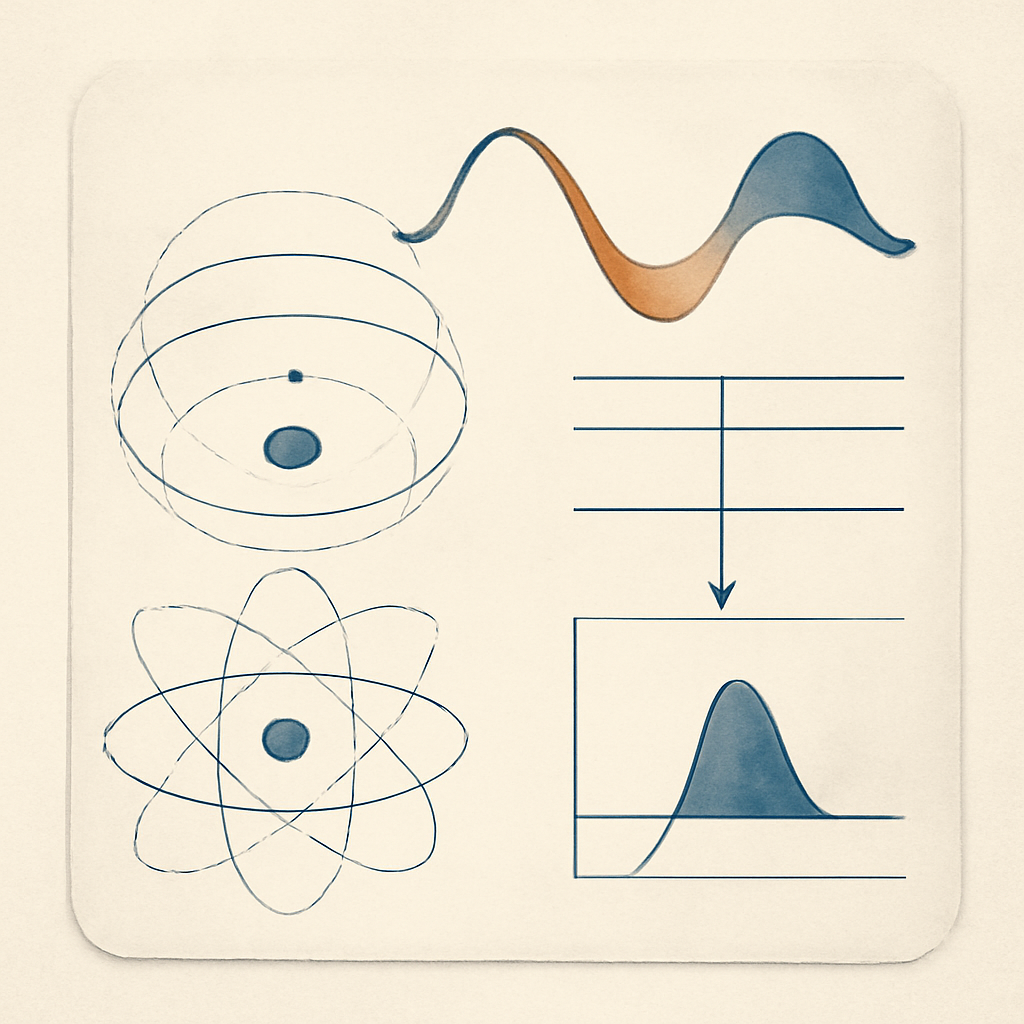
Quantum Foundations of Spectroscopic Transitions: Principles and Phenomena
Spectroscopic transitions hinge on the quantum nature of matter and light, revealing how discrete energy levels and wavefunction dynamics dictate absorption and emission processes. At the core is the quantization of energy states in atoms and molecules, which restricts electrons to specific orbitals and vibrational modes. Transitions between these states occur when photons of precise energies interact with the system, governed by selection rules derived from quantum mechanics and symmetry considerations. The time-dependent perturbation theory, particularly Fermi’s Golden Rule, mathematically captures transition probabilities, linking the microscopic quantum events to observable spectral lines.
Beyond simple energy quantization, phenomena like coherence, superposition, and entanglement subtly influence spectroscopic outcomes, especially in advanced techniques such as ultrafast spectroscopy and quantum-enhanced sensors. The coupling of electronic, vibrational, and rotational degrees of freedom introduces complexity, but also rich information about molecular structure and dynamics. Modern quantum optics tools and computational methods continue to refine our understanding, pushing spectroscopy into realms once thought inaccessible, from single-molecule detection to quantum state tomography.
✨
Wonder Moment
“Spectroscopic transitions are governed by the quantum mechanical probabilities encoded in transition dipole moments, dictating which electronic or vibrational changes are allowed or forbidden.”
Reflect
How might understanding the quantum rules behind spectroscopic transitions transform our ability to design new materials or probe biological systems at the molecular level?
2 sources·Established confidence·Investigated 21 Aug 2026(5 days ago)·Source-verified
Your next question, in
Visual Trail
See Quantum Foundations of Spectroscopic Transitions: Principles and Phenomena
A guided visual explanation assembled from QE artwork and sourced documentary images.
01 / 02
QE visual interpretation
Frame 01
Quantum Foundations of Spectroscopic Transitions: Principles and Phenomena
Spectroscopic transitions arise from quantum energy quantization and photon-induced electron state changes governed by selection rules.
Image provenance and limitation
Source: AI-generated visual interpretation
Creator: Question Everything
Limitation: This image explains or evokes the subject. It is not documentary evidence and should not be used to verify a factual claim.
Evidence
What do we know?
Verified claims with confidence scoring and cited sources.
1 of 3 findings need extra caution. Finding 3 rests on weaker sourcing than the other findings.
Living footnotes
Claims remain in the reading flow. Select a citation number to inspect the source behind it.
01
AcademicSupported
Spectroscopic transitions occur when electrons move between discrete quantum energy levels, absorbing or emitting photons with energy matching the level difference.
In quantum systems such as atoms or molecules, electrons occupy quantized energy states rather than a continuum. Transitions between these states require precise photon energies equal to the energy gap, leading to absorption or emission lines characteristic of the system's structure. This principle underpins spectroscopy’s ability to reveal chemical composition and electronic structure with high specificity.
02
AcademicSupported
The transition dipole moment integral determines whether a spectroscopic transition is allowed or forbidden based on the symmetry properties of the initial and final quantum states.
Quantum mechanics defines a transition moment integral involving wavefunctions and the dipole operator; if this integral is zero due to symmetry mismatches, the transition is forbidden. This selection rule explains why certain electronic or vibrational transitions never appear in spectra, shaping the patterns observed in infrared, Raman, and electronic spectroscopy.
03
AcademicNot confirmed
The Pauli Exclusion Principle restricts spectroscopic transitions by forbidding electron configurations with more than two electrons of opposite spins in the same orbital.
Beyond symmetry rules, the Pauli Exclusion Principle imposes fundamental constraints on allowed electronic transitions by preventing multiple electrons with identical quantum numbers from occupying the same orbital. This restricts possible final states, thereby influencing which spectroscopic lines manifest and which remain absent, critical for interpreting atomic and molecular spectra.
The complete record below preserves every citation, confidence input and recorded limitation.
Read the full evidence record3 findings · citations · limitations
Evidence review3 findings2 openable sources
01
Finding 1 of 3Academic
1
0/1 verified
Spectroscopic transitions occur when electrons move between discrete quantum energy levels, absorbing or emitting photons with energy matching the level difference.
In quantum systems such as atoms or molecules, electrons occupy quantized energy states rather than a continuum. Transitions between these states require precise photon energies equal to the energy gap, leading to absorption or emission lines characteristic of the system's structure. This principle underpins spectroscopy’s ability to reveal chemical composition and electronic structure with high specificity.
Supportedmodel score 95%
One source, not peer-reviewed. Thinner than the score suggests.
REFERENCE
›View sources and limits— 1 citation, limits
Supporting passage
In quantum systems such as atoms or molecules, electrons occupy quantized energy states rather than a continuum. Transitions between these states require precise photon energies equal to the energy gap, leading to absorption or emission lines characteristic of the system's structure. This principle underpins spectroscopy’s ability to reveal chemical composition and electronic structure with high specificity.
Rests on a single source. No independent corroboration.
No peer-reviewed source among the citations.
The generator scored this 95%, which would read as “Established”. Its citations reach only “Supported”, so that is what is shown.
02
Finding 2 of 3Academic
1
0/1 verified
The transition dipole moment integral determines whether a spectroscopic transition is allowed or forbidden based on the symmetry properties of the initial and final quantum states.
Quantum mechanics defines a transition moment integral involving wavefunctions and the dipole operator; if this integral is zero due to symmetry mismatches, the transition is forbidden. This selection rule explains why certain electronic or vibrational transitions never appear in spectra, shaping the patterns observed in infrared, Raman, and electronic spectroscopy.
Supportedmodel score 90%
One source, not peer-reviewed. Thinner than the score suggests.
REFERENCE
›View sources and limits— 1 citation, limits
Supporting passage
Quantum mechanics defines a transition moment integral involving wavefunctions and the dipole operator; if this integral is zero due to symmetry mismatches, the transition is forbidden. This selection rule explains why certain electronic or vibrational transitions never appear in spectra, shaping the patterns observed in infrared, Raman, and electronic spectroscopy.
1 of 2 citations failed verification and are not shown.
Rests on a single source. No independent corroboration.
No peer-reviewed source among the citations.
The generator scored this 90%, which would read as “Established”. Its citations reach only “Supported”, so that is what is shown.
03
Finding 3 of 3AcademicNeeds caution
0
0/0 verified
The Pauli Exclusion Principle restricts spectroscopic transitions by forbidding electron configurations with more than two electrons of opposite spins in the same orbital.
Beyond symmetry rules, the Pauli Exclusion Principle imposes fundamental constraints on allowed electronic transitions by preventing multiple electrons with identical quantum numbers from occupying the same orbital. This restricts possible final states, thereby influencing which spectroscopic lines manifest and which remain absent, critical for interpreting atomic and molecular spectra.
Not confirmedmodel score 30%
Scored as if sourced, but every citation failed verification.
NO SURVIVING CITATION
›View sources and limits— limits
Supporting passage
Beyond symmetry rules, the Pauli Exclusion Principle imposes fundamental constraints on allowed electronic transitions by preventing multiple electrons with identical quantum numbers from occupying the same orbital. This restricts possible final states, thereby influencing which spectroscopic lines manifest and which remain absent, critical for interpreting atomic and molecular spectra.
Citations (0 of 1 survived verification)
Nothing openable. Every citation was removed by provenance validation.
What limits this
All 1 citation on this claim failed verification and were removed. Nothing openable supports it.
The reference archive
Sources & Further Reading
Continue exploring the research, reporting and reference material available on this subject.
These were found while researching this question but are not used as evidence for any claim above.
These visualizations respond to your curiosity. Interact to go deeper.
process flow
Quantum Process of a Spectroscopic Transition
Initial Quantum State
Interaction with Photon
Transition Dipole Moment Evaluation
Allowed or Forbidden Transition
Emission or Absorption Observed
comparison table
Comparison of Allowed vs Forbidden Spectroscopic Transitions
Allowed Transitions
Forbidden Transitions
Transition Dipole Moment Value
Non-zero
Zero
Symmetry Requirements
Wavefunction symmetry matches dipole operator
Symmetry mismatch causes cancellation
Spectral Line Intensity
Strong or detectable
Weak or absent
Physical Implication
Transition occurs and can be measured
Transition highly improbable or forbidden
Tap any row to highlight and compare
Perspectives
How is this interpreted?
Enter a viewpoint. Notice what it reveals, what it leaves out, and whether it changes the question for you.
The EmpiricistScientific viewpointEstablished lens
Scientific understanding of spectroscopic transitions hinges on quantum mechanics, where wavefunctions and operators mathematically govern allowed energy exchanges. Observations such as selection rules emerge naturally from the formalism, linking symmetry and probability amplitudes. This framework enables precise predictions of spectra, facilitating advances in chemistry, materials science, and astrophysics by decoding electronic and vibrational structures.
What this lens notices
01Transition dipole moment integral governs allowed transitions
02Symmetry considerations determine forbidden states
03Quantum states are discrete and quantized
Application
Why does this matter to you?
Personal reflections and applications for your life.
Thought experimentPhilosophical
How does the quantum nature of spectroscopic transitions challenge our classical view of energy and observation?
Why it changes the question
Recognizing that allowed and forbidden transitions arise from abstract quantum rules invites us to rethink energy exchange as probabilistic and symmetry-dependent, not continuous and deterministic. This shift deepens our appreciation for the limits and power of observation in shaping physical reality.
Try this
Reflect on a classical system familiar to you and imagine how its behavior would change if governed by quantum selection rules.
Media
QE Smart Glass
Curated media selected for this investigation.
QE Glass
YOUTUBE
Physicist Brian Cox explains quantum physics in 22 minutes
Big Think
Become a Big Think member to unlock expert classes, premium print issues, exclusive events and more: ...
QE Glass
YOUTUBE
Without This Quantum Physics Hack, You'd Never Exist
Susskind Explained Universe
Discover the fascinating world of quantum physics and learn how it affects our everyday lives in this physics explained video.
QE Glass
YOUTUBE
Quantum Mechanics 36: The Gauge Miracle How Quantum Phase Forces Electromagnetism
DR. WOON KAI LIN
The video explore the concept of gauge invariance, a fundamental principle in physics stating that different mathematical labels ...
No AI help here — no suggestions, no autocomplete, nothing finishing your sentences. That is deliberate. Working out what you think is effortful, and the effort is the part that changes you: reasoning is trained like a muscle, and a muscle that is always carried gets weaker. Let something else do the thinking and you keep the answer but lose the capacity to have reached it.
Write your current position.
Not what the page says. What you think, having read it.0 words · Nothing written yet.
Sign in to leave a mark. Your draft is saved here in the meantime.