Inside every one of us, a quiet chemical symphony plays out every single day. We eat. The body breaks food down into glucose, our cellular fuel. The pancreas releases insulin, the vital key that unlocks our cells to let that fuel in. But when this elegant system breaks, the results are devastating. For millions, this is the daily reality of diabetes.
For decades, we have managed this condition. We have counted carbs, injected insulin, and monitored blood sugar. But management is not a cure. Today, we stand on the edge of a biological revolution. Scientists are no longer just trying to patch the system. They are trying to rebuild it from scratch.
From reprogramming stem cells in sterile labs to reversing metabolic damage through sheer weight loss, the hunt for a cure has taken two very different paths. One path targets the immune system's tragic mistake in Type 1. The other targets the cellular exhaustion of Type 2. The race is on, and the finish line is finally coming into view.
✨
Wonder Moment
“For thousands of years, Type 1 diabetes was a swift, agonizing death sentence. In 1922, scientists injected a dying, comatose 14-year-old boy named Leonard Thompson with a crude extract taken from a dog's pancreas. Within hours, his dangerously high blood sugar plummeted, his energy returned, and he lived another 13 years. It remains one of the most sudden and miraculous leaps in medical history.”
Reflect
If we successfully master stem cell therapy to cure diabetes, we will have unlocked the ability to rebuild human organs from scratch. What other failing biological systems will we replace next?
3 sources·Established confidence·Investigated 11 Jul 2026(1 month ago)·Investigation may be outdated
Your next question, in
Visual Trail
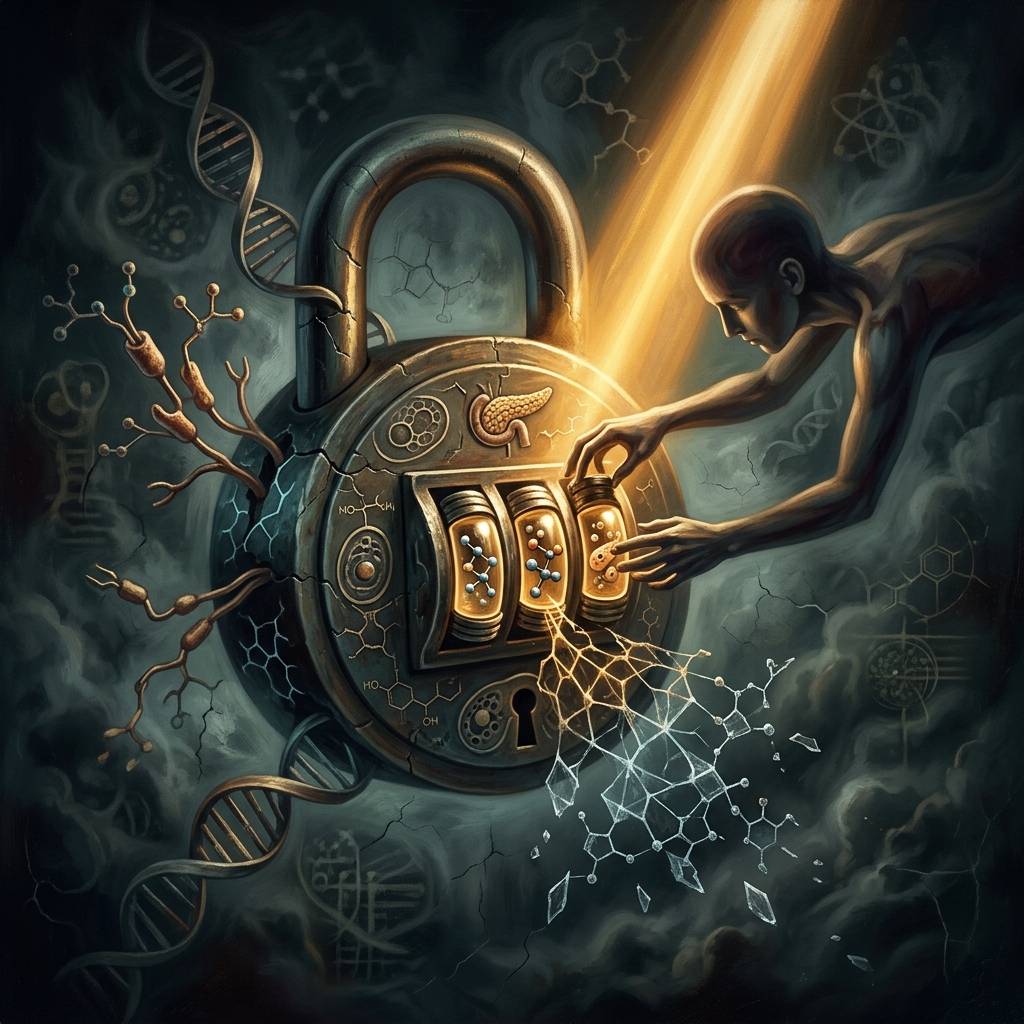
See The Sugar Code: Breaking the Diabetes Deadlock
A guided visual explanation assembled from QE artwork and sourced documentary images.
01 / 05
QE visual interpretation
Frame 01
The Sugar Code: Breaking the Diabetes Deadlock
No universal cure exists yet, but Type 2 can enter complete remission, and radical cellular therapies are bringing a Type 1 cure closer than ever.
Image provenance and limitation
Source: AI-generated visual interpretation
Creator: Question Everything
Limitation: This image explains or evokes the subject. It is not documentary evidence and should not be used to verify a factual claim.
Evidence
What do we know?
Verified claims with confidence scoring and cited sources.
Generated without source retrieval. QE did not fetch sources for this investigation, so no citation here was checked against a retrieved set. Claims reflect the model’s training data.
Living footnotes
Claims remain in the reading flow. Select a citation number to inspect the source behind it.
01
ExperimentalSupported
Type 2 diabetes can be put into complete remission through intensive weight management.
For years, Type 2 diabetes was seen as a one-way street. A progressive, life-long decline. But landmark medical trials have shattered this assumption. By losing significant weight, patients can literally drain the toxic fat choking their liver and pancreas. This allows the beta cells in the pancreas to wake up and start producing insulin normally again.
The DiRECT trial showed that nearly half of the participants who underwent an intensive weight management program achieved remission within one year. They did not need any diabetes medication. The key is catching it early. The shorter the time someone has lived with the disease, the higher the chance their pancreas can bounce back.
02
ObservationalSupported
Islet cell transplantation can free people with Type 1 diabetes from daily insulin injections.
In Type 1 diabetes, the body's own immune system turns rogue. It destroys the islet cells in the pancreas that make insulin. To fix this, doctors can take healthy islet cells from deceased organ donors and infuse them directly into a patient's liver. These transplanted cells settle down, find a blood supply, and start measuring blood sugar and releasing insulin naturally.
Known as the Edmonton Protocol, this treatment has successfully freed many patients from daily insulin injections. But there is a catch. The patient's immune system tries to destroy the new cells. To stop this, patients must take powerful drugs to suppress their immune system for the rest of their lives. These drugs carry heavy side effects, meaning this treatment is reserved only for the most severe cases.
03
ExperimentalSupported
Stem cell therapies are successfully growing new, insulin-producing cells to replace damaged ones.
Donor organs are rare. To cure millions, we need an endless supply of healthy beta cells. Scientists have now figured out how to guide human embryonic stem cells in a petri dish, turning them into fully functional, insulin-producing islet cells. This is no longer science fiction.
In recent clinical trials, patients with Type 1 diabetes received these lab-grown cells. The results were staggering. The cells successfully grafted into the patients' bodies, sensed blood sugar levels, and produced insulin. In some cases, patients achieved near-total insulin independence. The next hurdle is protecting these cells from immune attack without using harsh immunosuppressant drugs, perhaps by wrapping them in a microscopic, protective capsule.
The complete record below preserves every citation, confidence input and recorded limitation.
Read the full evidence record3 findings · citations · limitations
Evidence review3 findings3 openable sources
01
Finding 1 of 3Experimental
1
0/1 verified
Type 2 diabetes can be put into complete remission through intensive weight management.
For years, Type 2 diabetes was seen as a one-way street. A progressive, life-long decline. But landmark medical trials have shattered this assumption. By losing significant weight, patients can literally drain the toxic fat choking their liver and pancreas. This allows the beta cells in the pancreas to wake up and start producing insulin normally again.
The DiRECT trial showed that nearly half of the participants who underwent an intensive weight management program achieved remission within one year. They did not need any diabetes medication. The key is catching it early. The shorter the time someone has lived with the disease, the higher the chance their pancreas can bounce back.
Supportedmodel score 95%
A single peer-reviewed source. No independent corroboration.
PRIMARY STUDY
›View sources and limits— 1 citation, limits
Supporting passage
For years, Type 2 diabetes was seen as a one-way street. A progressive, life-long decline. But landmark medical trials have shattered this assumption. By losing significant weight, patients can literally drain the toxic fat choking their liver and pancreas. This allows the beta cells in the pancreas to wake up and start producing insulin normally again.
The DiRECT trial showed that nearly half of the participants who underwent an intensive weight management program achieved remission within one year. They did not need any diabetes medication. The key is catching it early. The shorter the time someone has lived with the disease, the higher the chance their pancreas can bounce back.
Generated without source retrieval — citations here were not verified against a retrieved set.
Rests on a single source. No independent corroboration.
The generator scored this 95%, which would read as “Established”. Its citations reach only “Supported”, so that is what is shown.
02
Finding 2 of 3Observational
0/1 verified
Islet cell transplantation can free people with Type 1 diabetes from daily insulin injections.
In Type 1 diabetes, the body's own immune system turns rogue. It destroys the islet cells in the pancreas that make insulin. To fix this, doctors can take healthy islet cells from deceased organ donors and infuse them directly into a patient's liver. These transplanted cells settle down, find a blood supply, and start measuring blood sugar and releasing insulin naturally.
Known as the Edmonton Protocol, this treatment has successfully freed many patients from daily insulin injections. But there is a catch. The patient's immune system tries to destroy the new cells. To stop this, patients must take powerful drugs to suppress their immune system for the rest of their lives. These drugs carry heavy side effects, meaning this treatment is reserved only for the most severe cases.
Supportedmodel score 90%
A single peer-reviewed source. No independent corroboration.
PRIMARY STUDY
›View sources and limits— 1 citation, limits
Supporting passage
In Type 1 diabetes, the body's own immune system turns rogue. It destroys the islet cells in the pancreas that make insulin. To fix this, doctors can take healthy islet cells from deceased organ donors and infuse them directly into a patient's liver. These transplanted cells settle down, find a blood supply, and start measuring blood sugar and releasing insulin naturally.
Known as the Edmonton Protocol, this treatment has successfully freed many patients from daily insulin injections. But there is a catch. The patient's immune system tries to destroy the new cells. To stop this, patients must take powerful drugs to suppress their immune system for the rest of their lives. These drugs carry heavy side effects, meaning this treatment is reserved only for the most severe cases.
Generated without source retrieval — citations here were not verified against a retrieved set.
Rests on a single source. No independent corroboration.
The generator scored this 90%, which would read as “Established”. Its citations reach only “Supported”, so that is what is shown.
03
Finding 3 of 3Experimental
1
0/1 verified
Stem cell therapies are successfully growing new, insulin-producing cells to replace damaged ones.
Donor organs are rare. To cure millions, we need an endless supply of healthy beta cells. Scientists have now figured out how to guide human embryonic stem cells in a petri dish, turning them into fully functional, insulin-producing islet cells. This is no longer science fiction.
In recent clinical trials, patients with Type 1 diabetes received these lab-grown cells. The results were staggering. The cells successfully grafted into the patients' bodies, sensed blood sugar levels, and produced insulin. In some cases, patients achieved near-total insulin independence. The next hurdle is protecting these cells from immune attack without using harsh immunosuppressant drugs, perhaps by wrapping them in a microscopic, protective capsule.
Supportedmodel score 85%
One source, not peer-reviewed. Thinner than the score suggests.
REPORTING
›View sources and limits— 1 citation, limits
Supporting passage
Donor organs are rare. To cure millions, we need an endless supply of healthy beta cells. Scientists have now figured out how to guide human embryonic stem cells in a petri dish, turning them into fully functional, insulin-producing islet cells. This is no longer science fiction.
In recent clinical trials, patients with Type 1 diabetes received these lab-grown cells. The results were staggering. The cells successfully grafted into the patients' bodies, sensed blood sugar levels, and produced insulin. In some cases, patients achieved near-total insulin independence. The next hurdle is protecting these cells from immune attack without using harsh immunosuppressant drugs, perhaps by wrapping them in a microscopic, protective capsule.
Generated without source retrieval — citations here were not verified against a retrieved set.
Rests on a single source. No independent corroboration.
No peer-reviewed source among the citations.
The generator scored this 85%, which would read as “Established”. Its citations reach only “Supported”, so that is what is shown.
Interactive Exploration
Touch, drag, and discover
These visualizations respond to your curiosity. Interact to go deeper.
comparison table
A Tale of Two Diseases
Type 1 Diabetes
Type 2 Diabetes
The Core Problem
An autoimmune attack destroys insulin-producing cells.
The body's cells become resistant to insulin, and the pancreas tires out.
Onset Age
Usually diagnosed in children and young adults.
Usually develops in adults, but increasingly found in younger people.
Body Weight
Not linked to body weight.
Strongly linked to excess body weight and physical inactivity.
Current 'Cure' Path
Stem cell transplants and immune-shielding technologies.
Metabolic reset through weight loss, diet, or bariatric surgery.
Tap any row to highlight and compare
process flow
The Road to Insulin Resistance
Glucose Overload
Insulin Flood
Cellular Deafness
Pancreatic Burnout
statistics card
The Global Footprint of Diabetes
537 Million
Adults living with diabetes globally
This is roughly 1 in 10 adults worldwide, a number expected to rise to 783 million by 2045.
90-95%
Proportion of cases that are Type 2
The vast majority of cases are heavily influenced by lifestyle and environment, meaning they are preventable.
46%
DiRECT trial participants in remission
Nearly half of the patients who lost over 10kg achieved complete drug-free remission from Type 2 diabetes within a year.
spectrum
The Glycemic Spectrum
Optimal SensitivityMetabolic Exhaustion
15%
Healthy Metabolism
50%
Insulin Resistance
75%
Prediabetes
95%
Type 2 Diabetes
Visual Gallery
Images & artifacts
Historical images, diagrams, and visual knowledge from Wikimedia Commons.
Perspectives
How is this interpreted?
Enter a viewpoint. Notice what it reveals, what it leaves out, and whether it changes the question for you.
The EmpiricistScientific viewpointLive tension
From a purely biological perspective, curing diabetes is a puzzle of cellular engineering and immune evasion. For Type 1, the scientific community is highly focused on stem cells and gene editing. If we can use CRISPR to modify stem-cell-derived beta cells so they are invisible to the immune system, we solve both the donor shortage and the need for immune-suppressing drugs. For Type 2, the science points toward metabolic rewiring, exploring how gut hormones (like GLP-1) can be harnessed to reset the body's weight and insulin sensitivity set-points.
What this lens notices
01Stem cell therapy removes the reliance on organ donors.
02CRISPR gene editing can make transplanted cells 'stealthy' to the immune system.
03GLP-1 receptor agonists are mimicking the natural gut signals to restore metabolic balance.
Application
Why does this matter to you?
Personal reflections and applications for your life.
Thought experimentPractical
How can you protect your own pancreas from insulin resistance starting today?
Why it changes the question
You do not have to wait for a medical crisis to protect your metabolism. Simple, strategic shifts in how you eat can dramatically lower the workload on your pancreas. When you eat carbohydrates, eat them alongside fiber, protein, or healthy fats. This simple sequencing slows down sugar absorption, preventing wild glucose spikes that exhaust your insulin-producing cells.
Try this
At your next meal, try eating your vegetables and proteins first, and leave the refined carbohydrates (like bread, pasta, or rice) for the end of the meal.
Media
QE Smart Glass
Curated media selected for this investigation.
QE Glass
YOUTUBE
Understanding Type 2 Diabetes
Animated Diabetes Patient
Learn more at: http://www.AnimatedDiabetesPatient.com This animation describes insulin resistance, an underlying cause of type ...
QE Glass
YOUTUBE
Understanding Diabetes: Type 1 vs Type 2 Explained | MedAnimations
Stanford CME
Explore the world of diabetes with our educational animated video, "Understanding Diabetes: Type 1 vs Type 2 Explained," ...
QE Glass
YOUTUBE
Type 2 diabetes | Sarah Hallberg | TEDxPurdueU
TEDx Talks
NOTE FROM TED: Do not look to this talk for medical advice. Significantly restricting dietary carbohydrates can have adverse ...
QE Glass
YOUTUBE
How There Could Finally Be A Cure For Diabetes
CNBC
Over the past 20 years, significant advancements in stem cell research and therapies have been one of the most promising ...
QE Glass
YOUTUBE
Diabetes Explained: What Happens Inside Your Body? | Understanding Blood Sugar & Insulin
Health Documentary
What is diabetes and why does it affect millions of people worldwide? In this first episode of our Diabetes Documentary Series, we ...
QE Glass
YOUTUBE
Pre Diabetes? How To Stop It From Progressing. Explained By Endocrinologist Dr Alice Cheng
Talking With Docs
On this episode of taking with docs Dr.Cheng endocrinologist talks about pre diabetes and certain things that night be causing you ...
QE Glass
YOUTUBE
How Diabetes Works
Kurzgesagt – In a Nutshell
An incredibly clear, visually stunning animation explaining the complex biology of insulin, glucose, and what happens when the pancreas fails.
QE Glass
PODCAST
Weight Loss Meds: Is This the End of Diabetes?
Science Vs
An engaging, evidence-based look at how the latest generation of weight loss and diabetes drugs (like Ozempic) are shifting the landscape of Type 2 treatment.
Keep Going
Where this leads
Questions this investigation opens up — and what QE has already looked into.
No AI help here — no suggestions, no autocomplete, nothing finishing your sentences. That is deliberate. Working out what you think is effortful, and the effort is the part that changes you: reasoning is trained like a muscle, and a muscle that is always carried gets weaker. Let something else do the thinking and you keep the answer but lose the capacity to have reached it.
Write your current position.
Not what the page says. What you think, having read it.0 words · Nothing written yet.
Sign in to leave a mark. Your draft is saved here in the meantime.