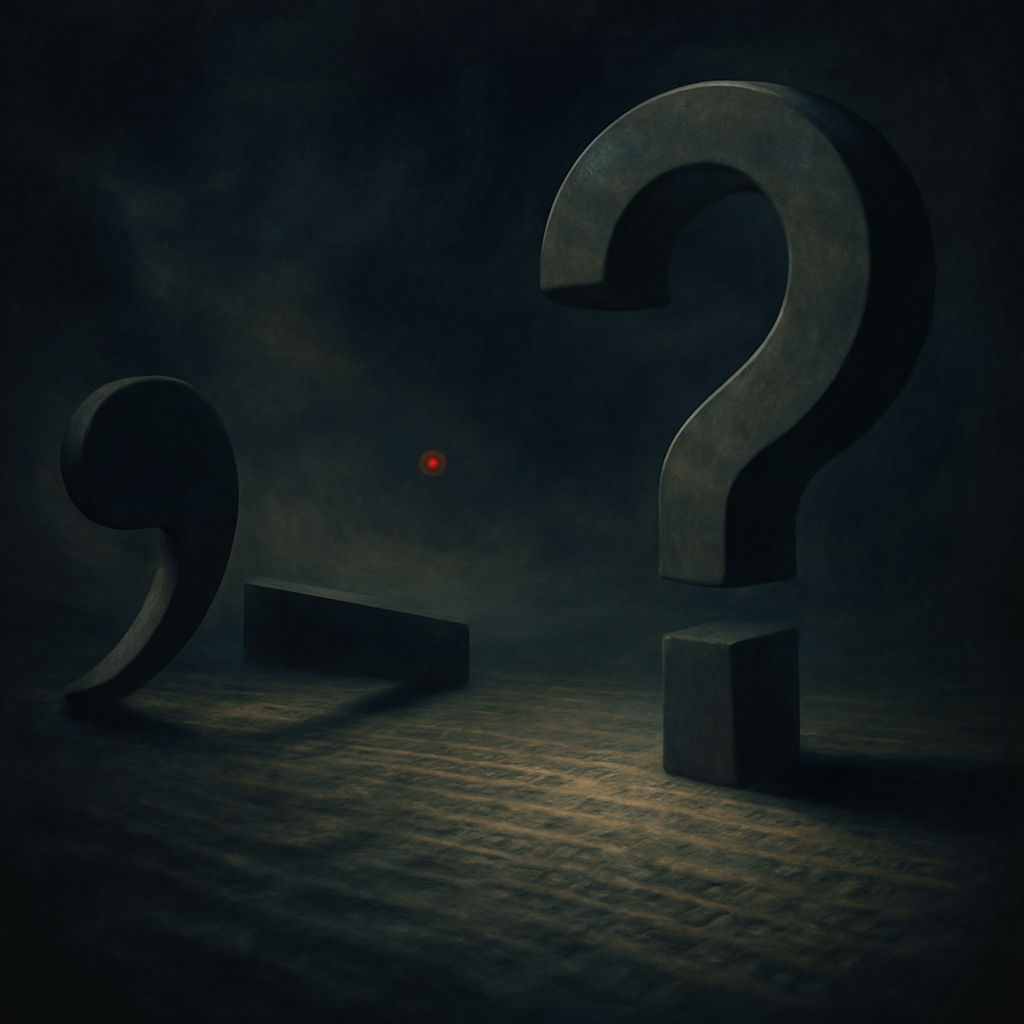
The Power of a Single Dot: Exploring the Meaning of '.'
A single dot, or period, is one of the simplest marks in writing, but it carries a lot of weight. It tells us when a sentence ends, giving our thoughts a clear pause. Without it, reading would be a confusing stream of words with no breaks. This tiny symbol helps us understand each other better by showing where ideas stop and new ones start.
But the dot is more than just a punctuation mark. In math, a dot can mean multiplication or a decimal point, changing numbers completely. In computer language, a dot can separate parts of a web address or a file name, guiding us to the right place online or on our devices. So, this little mark plays many roles in daily life—helping with reading, math, and technology.
“A tiny dot can end a sentence, change a number, and direct you to a website—all at once.”
Reflect
What everyday small symbols do you overlook that actually shape how you think and communicate?
2 sources·Established confidence·Investigated 16 Jul 2026(1 month ago)·Investigation may be outdated
Your next question, in
Visual Trail
See The Power of a Single Dot: Exploring the Meaning of '.'
A guided visual explanation assembled from QE artwork and sourced documentary images.
01 / 05
QE visual interpretation
Frame 01
The Power of a Single Dot: Exploring the Meaning of '.'
A single dot (.) marks the end of a sentence and plays key roles in writing, math, and technology.
Image provenance and limitation
Source: AI-generated visual interpretation
Creator: Question Everything
Limitation: This image explains or evokes the subject. It is not documentary evidence and should not be used to verify a factual claim.
Evidence
What do we know?
Verified claims with confidence scoring and cited sources.
Generated without source retrieval. QE did not fetch sources for this investigation, so no citation here was checked against a retrieved set. Claims reflect the model’s training data. 1 of 3 findings carry no openable link at all.
1 of 3 findings need extra caution. Finding 2 rests on weaker sourcing than the other findings.
Living footnotes
Claims remain in the reading flow. Select a citation number to inspect the source behind it.
01
HistoricalSupported
The period (.) is used to mark the end of a sentence in English writing.
In English grammar, the period is the most common punctuation mark used to signal that a sentence has finished. It gives readers a clear stop, helping to separate ideas and make text easier to understand. Without periods, sentences would run together, making reading confusing and tiring.
This use of the period dates back to ancient writing systems but became standardized in modern English during the 17th century. Today, it is a fundamental part of writing taught to all learners.
02
AcademicNot confirmed
In mathematics, a dot can represent multiplication or a decimal point.
Mathematicians use a dot in two main ways. First, a centered dot (·) often means multiplication, like 3 · 4 equals 12. Second, a dot placed between numbers acts as a decimal point, which separates the whole number from the fractional part, like 3.14.
These uses are universal and help in clear communication of numbers and calculations. Without the decimal point, we couldn't easily write or understand numbers smaller than one.
03
ObservationalSupported
In computer technology, a dot separates parts of web addresses and file names.
When you type a website like www.example.com, the dots separate different parts: 'www' stands for the web service, 'example' is the domain name, and 'com' is the top-level domain. Similarly, in file names like 'photo.jpg', the dot separates the file name from the file type, telling the computer how to open it.
This small mark helps computers organize and find information quickly and correctly. Without these dots, computers and the internet would be much harder to use.
The complete record below preserves every citation, confidence input and recorded limitation.
Read the full evidence record3 findings · citations · limitations
Evidence review3 findings2 openable sources
01
Finding 1 of 3Historical
2017
1 dated source
The period (.) is used to mark the end of a sentence in English writing.
In English grammar, the period is the most common punctuation mark used to signal that a sentence has finished. It gives readers a clear stop, helping to separate ideas and make text easier to understand. Without periods, sentences would run together, making reading confusing and tiring.
This use of the period dates back to ancient writing systems but became standardized in modern English during the 17th century. Today, it is a fundamental part of writing taught to all learners.
Supportedmodel score 100%
One source, not peer-reviewed. Thinner than the score suggests.
REPORTING
›View sources and limits— 1 citation, limits
Supporting passage
In English grammar, the period is the most common punctuation mark used to signal that a sentence has finished. It gives readers a clear stop, helping to separate ideas and make text easier to understand. Without periods, sentences would run together, making reading confusing and tiring.
This use of the period dates back to ancient writing systems but became standardized in modern English during the 17th century. Today, it is a fundamental part of writing taught to all learners.
Generated without source retrieval — citations here were not verified against a retrieved set.
Rests on a single source. No independent corroboration.
No peer-reviewed source among the citations.
The generator scored this 100%, which would read as “Established”. Its citations reach only “Supported”, so that is what is shown.
02
Finding 2 of 3AcademicNeeds caution
0
0/0 verified
In mathematics, a dot can represent multiplication or a decimal point.
Mathematicians use a dot in two main ways. First, a centered dot (·) often means multiplication, like 3 · 4 equals 12. Second, a dot placed between numbers acts as a decimal point, which separates the whole number from the fractional part, like 3.14.
These uses are universal and help in clear communication of numbers and calculations. Without the decimal point, we couldn't easily write or understand numbers smaller than one.
Not confirmedmodel score 95%
Written from the model's own knowledge. No source was retrieved or checked.
UNVERIFIED — NO RETRIEVAL
›View sources and limits— limits
Supporting passage
Mathematicians use a dot in two main ways. First, a centered dot (·) often means multiplication, like 3 · 4 equals 12. Second, a dot placed between numbers acts as a decimal point, which separates the whole number from the fractional part, like 3.14.
These uses are universal and help in clear communication of numbers and calculations. Without the decimal point, we couldn't easily write or understand numbers smaller than one.
Citations (0 of 1 survived verification)
Nothing openable. No sources were retrieved for this investigation, so none were checked.
What limits this
This investigation was generated without source retrieval. The model named a source but gave no link, and no verification step ran against it.
The claim reflects the model's training data, not a checked citation.
The generator scored this 95%, which would read as “Established”. Its citations reach only “Unresolved”, so that is what is shown.
03
Finding 3 of 3Observational
0/1 verified
In computer technology, a dot separates parts of web addresses and file names.
When you type a website like www.example.com, the dots separate different parts: 'www' stands for the web service, 'example' is the domain name, and 'com' is the top-level domain. Similarly, in file names like 'photo.jpg', the dot separates the file name from the file type, telling the computer how to open it.
This small mark helps computers organize and find information quickly and correctly. Without these dots, computers and the internet would be much harder to use.
Supportedmodel score 98%
One source, not peer-reviewed. Thinner than the score suggests.
REPORTING
›View sources and limits— 1 citation, limits
Supporting passage
When you type a website like www.example.com, the dots separate different parts: 'www' stands for the web service, 'example' is the domain name, and 'com' is the top-level domain. Similarly, in file names like 'photo.jpg', the dot separates the file name from the file type, telling the computer how to open it.
This small mark helps computers organize and find information quickly and correctly. Without these dots, computers and the internet would be much harder to use.
Generated without source retrieval — citations here were not verified against a retrieved set.
Rests on a single source. No independent corroboration.
No peer-reviewed source among the citations.
The generator scored this 98%, which would read as “Established”. Its citations reach only “Supported”, so that is what is shown.
Interactive Exploration
Touch, drag, and discover
These visualizations respond to your curiosity. Interact to go deeper.
hierarchy
Uses of the Dot (.) Symbol
Building hierarchy…
Tap nodes to explore the hierarchy
process flow
How a Dot Organizes a Web Address
Start with www
Domain name
Top-level domain
statistics card
Dot in Writing and Technology Stats
100%
English sentences ending with a period
Standard punctuation rule
Over 1.8 billion
Websites using dots in URLs
Dots separate domain parts
Decimal system
Used worldwide
Dots as decimal points
spectrum
Dot Functions from Simple to Complex
Basic WritingAdvanced Technology
10%
Period for sentences
50%
Decimal point
90%
URL separator
Visual Gallery
Images & artifacts
Historical images, diagrams, and visual knowledge from Wikimedia Commons.
Perspectives
How is this interpreted?
Enter a viewpoint. Notice what it reveals, what it leaves out, and whether it changes the question for you.
The EmpiricistScientific viewpointEstablished lens
From a scientific view, the dot is a sign system element that carries meaning far beyond its size. It is a basic unit in language that helps break down complex thoughts into understandable parts. Scientists in linguistics study how such small marks impact reading speed and comprehension. The dot acts like a signal in the brain, telling us when to pause and prepare for the next idea.
What this lens notices
01Punctuation marks improve reading comprehension.
02Small visual cues help brain processing of language.
03Standard symbols aid clear communication.
Application
Why does this matter to you?
Personal reflections and applications for your life.
Thought experimentSelf-Reflection
Have you ever noticed how a missing period changes the meaning of a message?
Why it changes the question
Missing punctuation can cause confusion or change how people understand your words. Paying attention to small marks helps you communicate clearly and avoid misunderstandings.
Try this
Try writing a short message twice: once with proper punctuation and once without. Notice how much easier it is to understand with the correct dots and stops.
Media
QE Smart Glass
Curated media selected for this investigation.
QE Glass
YOUTUBE
Salvador Dali: Great Art Explained
Great Art Explained
My other channel, Great Books Explained here - https://www.youtube.com/@greatbooksexplained371 Please consider supporting ...
QE Glass
YOUTUBE
Frida Kahlo's 'The Two Fridas’: Great Art Explained
Great Art Explained
My other channel, Great Books Explained here - https://www.youtube.com/@greatbooksexplained371 Please consider supporting ...
QE Glass
YOUTUBE
The Milkmaid by Johannes Vermeer: Great Art Explained
Great Art Explained
My other channel, Great Books Explained here - https://www.youtube.com/@greatbooksexplained371 Please consider supporting ...
QE Glass
YOUTUBE
The School of Athens by Raphael: Great Art Explained
Great Art Explained
The first 1000 people to click the link will get a full year of Premium membership to Craftsy for only $1.49: ...
QE Glass
YOUTUBE
Great Art Explained: The Last Supper by Leonardo da Vinci
Great Art Explained
My other channel, Great Books Explained here - https://www.youtube.com/@greatbooksexplained371 Please consider supporting ...
QE Glass
YOUTUBE
How Renaissance artists were trained
Art Uncovered
Have you ever wondered how iconic artists like Michelangelo and Leonardo da Vinci learned their craft during the Renaissance ...
QE Glass
YOUTUBE
The History of Punctuation - TED-Ed
TED-Ed
A clear, engaging video explaining how punctuation marks like the period came to be and why they matter.
QE Glass
YOUTUBE
How Domain Names Work - Kurzgesagt
Kurzgesagt – In a Nutshell
Explains the role of dots in web addresses and how the internet uses them to find websites.
QE Glass
PODCAST
Ologies Podcast: Semiotics - The Study of Signs
Ologies with Alie Ward
A fun dive into how small symbols like dots carry big meanings in language and culture.
Keep Going
Where this leads
Questions this investigation opens up — and what QE has already looked into.
No AI help here — no suggestions, no autocomplete, nothing finishing your sentences. That is deliberate. Working out what you think is effortful, and the effort is the part that changes you: reasoning is trained like a muscle, and a muscle that is always carried gets weaker. Let something else do the thinking and you keep the answer but lose the capacity to have reached it.
Write your current position.
Not what the page says. What you think, having read it.0 words · Nothing written yet.
Sign in to leave a mark. Your draft is saved here in the meantime.