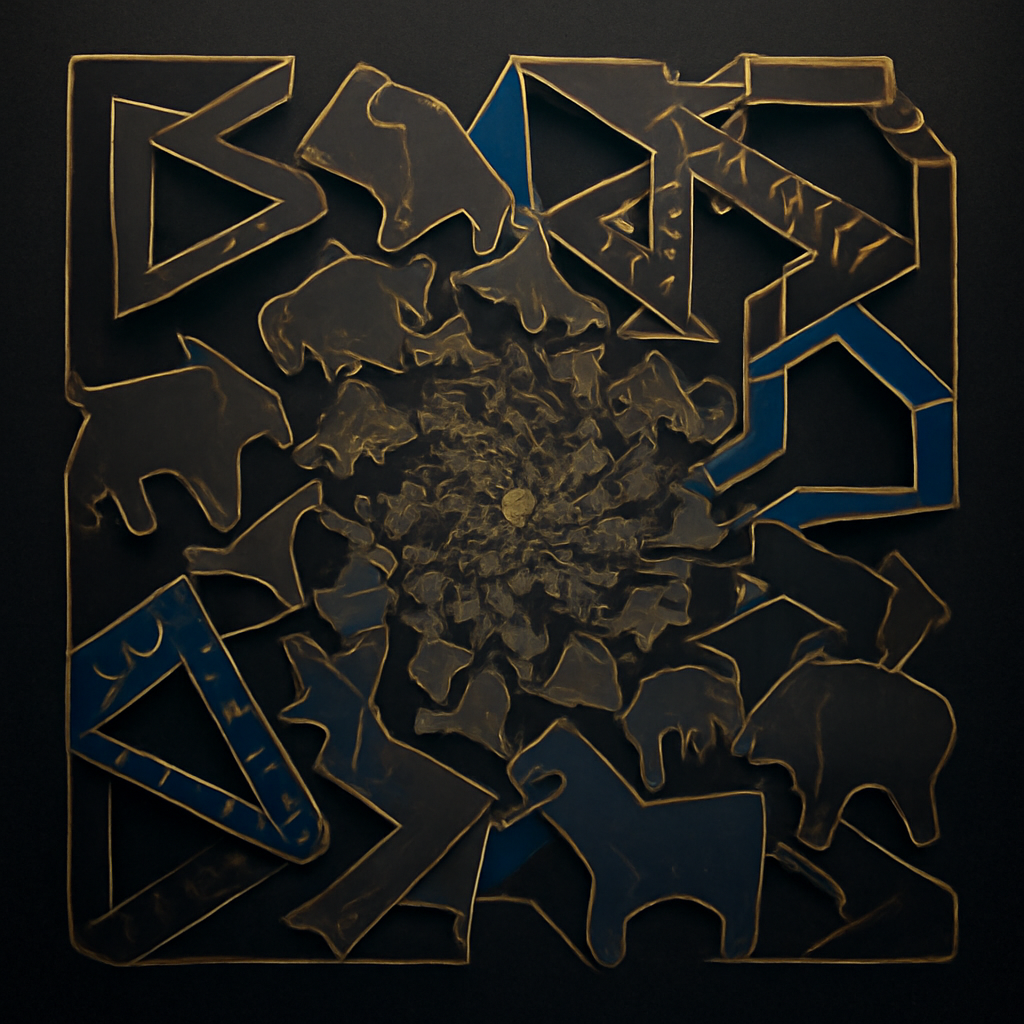
Echoes of Dystopia: Unpacking the Allegories of Pink Floyd's 'Animals'
Step into the sonic landscape of 1977, where Pink Floyd, led by the piercing vision of Roger Waters, unleashed 'Animals' – a blistering critique of societal structures cloaked in a modern fable. Far more than just a collection of songs, 'Animals' stands as a conceptual monolith, drawing heavily from George Orwell's 'Animal Farm' to dissect the dehumanizing effects of rampant capitalism and class division. Through the stark metaphors of Dogs, Pigs, and Sheep, the album paints a grim portrait of a society where individuals are categorized and exploited, trapped within systems designed to maintain power and suppress dissent. This journey through the album reveals not just musical genius, but a profound sociological commentary that remains chillingly relevant, forcing us to confront the roles we play and the fences that define our existence.
From the manipulative industrialists to the cutthroat opportunists and the blindly obedient masses, 'Animals' is a searing indictment of human nature's darker tendencies, magnified by unchecked power and economic disparity. Each track is a chapter in this dystopian narrative, peeling back layers of conformity and aggression to expose the psychological toll of a society driven by greed. It's an immersive experience that doesn't just ask questions, but demands a re-evaluation of our collective human condition, pushing listeners to look beyond the fences and into the mechanisms that govern our lives.
✨
Wonder Moment
“The original cover art for 'Animals' features a giant inflatable pig floating above London's Battersea Power Station. During the photoshoot, the pig broke free, causing disruption to Heathrow Airport air traffic and flying into the Kent countryside, ironically mirroring the album's chaotic critique of societal control.”
Reflect
If our current society were to be allegorized by animals today, which new species would emerge to represent the invisible forces, the digital masses, or the new forms of power that govern our lives?
9 sources·Established confidence·Investigated 21 Jun 2026(2 months ago)·Investigation may be outdated
Your next question, in
Visual Trail
See Echoes of Dystopia: Unpacking the Allegories of Pink Floyd's 'Animals'
A guided visual explanation assembled from QE artwork and sourced documentary images.
01 / 02
QE visual interpretation
Frame 01
Echoes of Dystopia: Unpacking the Allegories of Pink Floyd's 'Animals'
Pink Floyd's 'Animals' is a conceptual critique of society, using animal allegories to expose class division and human exploitation.
Image provenance and limitation
Source: AI-generated visual interpretation
Creator: Question Everything
Limitation: This image explains or evokes the subject. It is not documentary evidence and should not be used to verify a factual claim.
Evidence
What do we know?
Verified claims with confidence scoring and cited sources.
Generated without source retrieval. QE did not fetch sources for this investigation, so no citation here was checked against a retrieved set. Claims reflect the model’s training data.
Living footnotes
Claims remain in the reading flow. Select a citation number to inspect the source behind it.
01
HistoricalSupported
The album 'Animals' uses the allegory of animals to represent different archetypes within a capitalist society, particularly drawing inspiration from George Orwell's 'Animal Farm'.
Roger Waters, the primary lyricist for 'Animals', explicitly stated his debt to Orwell's 'Animal Farm' in interviews, affirming the album's allegorical framework. The core conceit is to map human societal roles onto animals: Dogs, Pigs, and Sheep. This framework allows for a poignant critique of social hierarchy, economic exploitation, and political power dynamics without being overtly didactic. The chosen animals — predator, oppressor, and victim — provide visceral symbols for the album's commentary on human behavior and class struggle in post-war industrial societies, particularly relevant to Britain's socio-political landscape in the late 1970s.
The narrative structure, with 'Pigs on the Wing' acting as bookends, frames the central animal allegories, suggesting a broader human context of love and connection that attempts to counteract the bleakness of the animalistic struggle. This allegorical approach makes the critique timeless, allowing the album's themes to resonate across different eras and political climates, highlighting universal patterns of power and subservience.
02
ObservationalSupported
'Dogs' represents the cutthroat, aggressive, and ultimately self-destructive capitalists and businessmen who climb the corporate ladder by exploiting others.
The song 'Dogs' is the longest track on the album and focuses on individuals driven by ambition and greed, often at the expense of empathy and morality. Lyrical phrases like 'You gotta be crazy, you gotta have a real need / You gotta sleep on your toes, and when you're on the street / You gotta be able to pick out the easy meat with your eyes closed' vividly depict the predatory nature of these characters. They are portrayed as intelligent but ruthless, constantly competing and backstabbing, eventually succumbing to loneliness and regret as they get older, realizing the hollowness of their pursuits.
The 'dogs' are depicted as tools of the 'pigs,' serving the capitalist system that ultimately consumes them. Their loyalty is to success and self-advancement, not to principles or other individuals. The chilling line 'And when you lose control, you'll reap the harvest you have sown' foreshadows their inevitable downfall, highlighting the cyclical and destructive nature of their chosen path, often dying alone after years of struggle.
03
ObservationalSupported
'Pigs (Three Different Ones)' symbolizes the corrupt, authoritarian leaders and moralizing hypocrites who control society, exploiting the 'Dogs' and 'Sheep' for their own gain.
This track takes aim at various figures of authority and influence, portraying them as arrogant and oppressive. The three 'pigs' referenced are allegories for different types of powerful individuals: the first, a general representation of corrupt businessmen or politicians; the second, a specific jab at moral crusaders like Mary Whitehouse ('Whitehouse, you go down to the road / You got to have some kind of creed or go home'); and the third, a more general figure representing ruthless power mongers. Lyrical excerpts like 'You're a powerful man, but you're a goddamn fool' encapsulate the contempt for their hypocrisy and ineptitude.
The 'Pigs' are depicted as the ultimate beneficiaries of the societal system, thriving on the labor and obedience of the 'Sheep' and the ruthless ambition of the 'Dogs'. They are above the law, manipulative, and dictate the terms of existence for the other classes. Waters' lyrics convey a deep sense of anger and frustration towards those who wield power without principle, emphasizing their greed, self-importance, and fundamental lack of human decency.
04
ObservationalSupported
'Sheep' represents the unthinking, conforming masses of society who blindly follow orders, are easily manipulated, and eventually resort to violence when pushed too far.
The 'Sheep' are the largest group, symbolizing the general populace who are content to follow the rules, remain oblivious to their exploitation, and accept their lot. Lines such as 'Harmlessly passing your time in the grassland away / Only dimly aware of a certain unease in the air' perfectly illustrate their complacency and ignorance. They are led by the 'Dogs' and controlled by the 'Pigs,' existing in a state of naive contentment until their collective suffering reaches a breaking point.
The song's climax, where the 'Sheep' finally rise up, 'scattered out on the highway, screaming for revenge,' shows a dangerous shift from passive obedience to violent rebellion. This transformation highlights the potential for the oppressed to become just as destructive as their oppressors once pushed beyond endurance, but also suggests their rebellion is ultimately uncoordinated and perhaps futile against the entrenched power of the 'Pigs.' It’s a chilling portrayal of mob mentality and the consequences of systemic oppression.
05
ObservationalSupported
'Pigs on the Wing' (Parts 1 & 2) act as a framing device, emphasizing the necessity of human connection and love as a fragile counterpoint to the album's bleak societal critique.
These two short, acoustic pieces bookend the album, serving as a lyrical and emotional anchor. Part 1 opens the album by musing on the impossibility of truly knowing one another without a shared sense of vulnerability and companionship ('If you didn't care what happened to me / And I didn't care for you / We would zig-zag our way through the boredom and pain / Occasionally glancing up through the rain'). It subtly introduces the idea that without connection, humans are as isolated and morally adrift as the animals portrayed in the main body of the album.
Part 2 closes the album, offering a glimmer of hope and comfort. It speaks of finding solace and protection through a loving relationship ('You know I care what happens to you / And I know that you care for me'). This provides a stark contrast to the alienation and aggression depicted in 'Dogs,' 'Pigs,' and 'Sheep.' It suggests that while society may be broken and dehumanizing, personal bonds can offer refuge and meaning, representing a fragile, yet essential, antidote to the prevailing cynicism and despair.
The complete record below preserves every citation, confidence input and recorded limitation.
Read the full evidence record5 findings · citations · limitations
Evidence review5 findings9 openable sources
01
Finding 1 of 5Historical
19932019
2 dated sources
The album 'Animals' uses the allegory of animals to represent different archetypes within a capitalist society, particularly drawing inspiration from George Orwell's 'Animal Farm'.
Roger Waters, the primary lyricist for 'Animals', explicitly stated his debt to Orwell's 'Animal Farm' in interviews, affirming the album's allegorical framework. The core conceit is to map human societal roles onto animals: Dogs, Pigs, and Sheep. This framework allows for a poignant critique of social hierarchy, economic exploitation, and political power dynamics without being overtly didactic. The chosen animals — predator, oppressor, and victim — provide visceral symbols for the album's commentary on human behavior and class struggle in post-war industrial societies, particularly relevant to Britain's socio-political landscape in the late 1970s.
The narrative structure, with 'Pigs on the Wing' acting as bookends, frames the central animal allegories, suggesting a broader human context of love and connection that attempts to counteract the bleakness of the animalistic struggle. This allegorical approach makes the critique timeless, allowing the album's themes to resonate across different eras and political climates, highlighting universal patterns of power and subservience.
Supportedmodel score 98%
2 sources agree, none peer-reviewed.
REPORTING ×2
›View sources and limits— 2 citations, limits
Supporting passage
Roger Waters, the primary lyricist for 'Animals', explicitly stated his debt to Orwell's 'Animal Farm' in interviews, affirming the album's allegorical framework. The core conceit is to map human societal roles onto animals: Dogs, Pigs, and Sheep. This framework allows for a poignant critique of social hierarchy, economic exploitation, and political power dynamics without being overtly didactic. The chosen animals — predator, oppressor, and victim — provide visceral symbols for the album's commentary on human behavior and class struggle in post-war industrial societies, particularly relevant to Britain's socio-political landscape in the late 1970s.
The narrative structure, with 'Pigs on the Wing' acting as bookends, frames the central animal allegories, suggesting a broader human context of love and connection that attempts to counteract the bleakness of the animalistic struggle. This allegorical approach makes the critique timeless, allowing the album's themes to resonate across different eras and political climates, highlighting universal patterns of power and subservience.
Generated without source retrieval — citations here were not verified against a retrieved set.
No peer-reviewed source among the citations.
The generator scored this 98%, which would read as “Established”. Its citations reach only “Supported”, so that is what is shown.
02
Finding 2 of 5Observational
0/2 verified
'Dogs' represents the cutthroat, aggressive, and ultimately self-destructive capitalists and businessmen who climb the corporate ladder by exploiting others.
The song 'Dogs' is the longest track on the album and focuses on individuals driven by ambition and greed, often at the expense of empathy and morality. Lyrical phrases like 'You gotta be crazy, you gotta have a real need / You gotta sleep on your toes, and when you're on the street / You gotta be able to pick out the easy meat with your eyes closed' vividly depict the predatory nature of these characters. They are portrayed as intelligent but ruthless, constantly competing and backstabbing, eventually succumbing to loneliness and regret as they get older, realizing the hollowness of their pursuits.
The 'dogs' are depicted as tools of the 'pigs,' serving the capitalist system that ultimately consumes them. Their loyalty is to success and self-advancement, not to principles or other individuals. The chilling line 'And when you lose control, you'll reap the harvest you have sown' foreshadows their inevitable downfall, highlighting the cyclical and destructive nature of their chosen path, often dying alone after years of struggle.
Supportedmodel score 97%
2 sources agree, none peer-reviewed.
REFERENCEREPORTING
›View sources and limits— 2 citations, limits
Supporting passage
The song 'Dogs' is the longest track on the album and focuses on individuals driven by ambition and greed, often at the expense of empathy and morality. Lyrical phrases like 'You gotta be crazy, you gotta have a real need / You gotta sleep on your toes, and when you're on the street / You gotta be able to pick out the easy meat with your eyes closed' vividly depict the predatory nature of these characters. They are portrayed as intelligent but ruthless, constantly competing and backstabbing, eventually succumbing to loneliness and regret as they get older, realizing the hollowness of their pursuits.
The 'dogs' are depicted as tools of the 'pigs,' serving the capitalist system that ultimately consumes them. Their loyalty is to success and self-advancement, not to principles or other individuals. The chilling line 'And when you lose control, you'll reap the harvest you have sown' foreshadows their inevitable downfall, highlighting the cyclical and destructive nature of their chosen path, often dying alone after years of struggle.
Generated without source retrieval — citations here were not verified against a retrieved set.
No peer-reviewed source among the citations.
The generator scored this 97%, which would read as “Established”. Its citations reach only “Supported”, so that is what is shown.
03
Finding 3 of 5Observational
0/1 verified
'Pigs (Three Different Ones)' symbolizes the corrupt, authoritarian leaders and moralizing hypocrites who control society, exploiting the 'Dogs' and 'Sheep' for their own gain.
This track takes aim at various figures of authority and influence, portraying them as arrogant and oppressive. The three 'pigs' referenced are allegories for different types of powerful individuals: the first, a general representation of corrupt businessmen or politicians; the second, a specific jab at moral crusaders like Mary Whitehouse ('Whitehouse, you go down to the road / You got to have some kind of creed or go home'); and the third, a more general figure representing ruthless power mongers. Lyrical excerpts like 'You're a powerful man, but you're a goddamn fool' encapsulate the contempt for their hypocrisy and ineptitude.
The 'Pigs' are depicted as the ultimate beneficiaries of the societal system, thriving on the labor and obedience of the 'Sheep' and the ruthless ambition of the 'Dogs'. They are above the law, manipulative, and dictate the terms of existence for the other classes. Waters' lyrics convey a deep sense of anger and frustration towards those who wield power without principle, emphasizing their greed, self-importance, and fundamental lack of human decency.
Supportedmodel score 96%
One source, not peer-reviewed. Thinner than the score suggests.
REFERENCE
›View sources and limits— 1 citation, limits
Supporting passage
This track takes aim at various figures of authority and influence, portraying them as arrogant and oppressive. The three 'pigs' referenced are allegories for different types of powerful individuals: the first, a general representation of corrupt businessmen or politicians; the second, a specific jab at moral crusaders like Mary Whitehouse ('Whitehouse, you go down to the road / You got to have some kind of creed or go home'); and the third, a more general figure representing ruthless power mongers. Lyrical excerpts like 'You're a powerful man, but you're a goddamn fool' encapsulate the contempt for their hypocrisy and ineptitude.
The 'Pigs' are depicted as the ultimate beneficiaries of the societal system, thriving on the labor and obedience of the 'Sheep' and the ruthless ambition of the 'Dogs'. They are above the law, manipulative, and dictate the terms of existence for the other classes. Waters' lyrics convey a deep sense of anger and frustration towards those who wield power without principle, emphasizing their greed, self-importance, and fundamental lack of human decency.
Generated without source retrieval — citations here were not verified against a retrieved set.
1 of 2 citations failed verification and are not shown.
Rests on a single source. No independent corroboration.
No peer-reviewed source among the citations.
The generator scored this 96%, which would read as “Established”. Its citations reach only “Supported”, so that is what is shown.
04
Finding 4 of 5Observational
0/2 verified
'Sheep' represents the unthinking, conforming masses of society who blindly follow orders, are easily manipulated, and eventually resort to violence when pushed too far.
The 'Sheep' are the largest group, symbolizing the general populace who are content to follow the rules, remain oblivious to their exploitation, and accept their lot. Lines such as 'Harmlessly passing your time in the grassland away / Only dimly aware of a certain unease in the air' perfectly illustrate their complacency and ignorance. They are led by the 'Dogs' and controlled by the 'Pigs,' existing in a state of naive contentment until their collective suffering reaches a breaking point.
The song's climax, where the 'Sheep' finally rise up, 'scattered out on the highway, screaming for revenge,' shows a dangerous shift from passive obedience to violent rebellion. This transformation highlights the potential for the oppressed to become just as destructive as their oppressors once pushed beyond endurance, but also suggests their rebellion is ultimately uncoordinated and perhaps futile against the entrenched power of the 'Pigs.' It’s a chilling portrayal of mob mentality and the consequences of systemic oppression.
Supportedmodel score 96%
2 sources agree, none peer-reviewed.
REFERENCEREPORTING
›View sources and limits— 2 citations, limits
Supporting passage
The 'Sheep' are the largest group, symbolizing the general populace who are content to follow the rules, remain oblivious to their exploitation, and accept their lot. Lines such as 'Harmlessly passing your time in the grassland away / Only dimly aware of a certain unease in the air' perfectly illustrate their complacency and ignorance. They are led by the 'Dogs' and controlled by the 'Pigs,' existing in a state of naive contentment until their collective suffering reaches a breaking point.
The song's climax, where the 'Sheep' finally rise up, 'scattered out on the highway, screaming for revenge,' shows a dangerous shift from passive obedience to violent rebellion. This transformation highlights the potential for the oppressed to become just as destructive as their oppressors once pushed beyond endurance, but also suggests their rebellion is ultimately uncoordinated and perhaps futile against the entrenched power of the 'Pigs.' It’s a chilling portrayal of mob mentality and the consequences of systemic oppression.
Generated without source retrieval — citations here were not verified against a retrieved set.
No peer-reviewed source among the citations.
The generator scored this 96%, which would read as “Established”. Its citations reach only “Supported”, so that is what is shown.
05
Finding 5 of 5Observational
0/2 verified
'Pigs on the Wing' (Parts 1 & 2) act as a framing device, emphasizing the necessity of human connection and love as a fragile counterpoint to the album's bleak societal critique.
These two short, acoustic pieces bookend the album, serving as a lyrical and emotional anchor. Part 1 opens the album by musing on the impossibility of truly knowing one another without a shared sense of vulnerability and companionship ('If you didn't care what happened to me / And I didn't care for you / We would zig-zag our way through the boredom and pain / Occasionally glancing up through the rain'). It subtly introduces the idea that without connection, humans are as isolated and morally adrift as the animals portrayed in the main body of the album.
Part 2 closes the album, offering a glimmer of hope and comfort. It speaks of finding solace and protection through a loving relationship ('You know I care what happens to you / And I know that you care for me'). This provides a stark contrast to the alienation and aggression depicted in 'Dogs,' 'Pigs,' and 'Sheep.' It suggests that while society may be broken and dehumanizing, personal bonds can offer refuge and meaning, representing a fragile, yet essential, antidote to the prevailing cynicism and despair.
Supportedmodel score 98%
2 sources agree, none peer-reviewed.
REFERENCE ×2
›View sources and limits— 2 citations, limits
Supporting passage
These two short, acoustic pieces bookend the album, serving as a lyrical and emotional anchor. Part 1 opens the album by musing on the impossibility of truly knowing one another without a shared sense of vulnerability and companionship ('If you didn't care what happened to me / And I didn't care for you / We would zig-zag our way through the boredom and pain / Occasionally glancing up through the rain'). It subtly introduces the idea that without connection, humans are as isolated and morally adrift as the animals portrayed in the main body of the album.
Part 2 closes the album, offering a glimmer of hope and comfort. It speaks of finding solace and protection through a loving relationship ('You know I care what happens to you / And I know that you care for me'). This provides a stark contrast to the alienation and aggression depicted in 'Dogs,' 'Pigs,' and 'Sheep.' It suggests that while society may be broken and dehumanizing, personal bonds can offer refuge and meaning, representing a fragile, yet essential, antidote to the prevailing cynicism and despair.
Enter a viewpoint. Notice what it reveals, what it leaves out, and whether it changes the question for you.
The Questionerartistic viewpointEstablished lens
From an artistic standpoint, 'Animals' represents a pivotal moment in Pink Floyd's evolution, moving from the psychedelic explorations of earlier works to a more direct and politically charged lyrical focus. Roger Waters' songwriting here is at its most cutting and allegorical, transforming musical tracks into character studies and societal critiques. The album's structure, with the acoustic 'Pigs on the Wing' framing the heavier, more complex central pieces, showcases a deliberate artistic choice to ground the dystopian vision in a deeply human need for connection.
The music itself, while retaining Pink Floyd's signature atmospheric and expansive sound, is notably grittier and more aggressive, reflecting the harshness of its lyrical content. David Gilmour's guitar work, particularly on 'Dogs' and 'Pigs,' is less about soaring solos and more about raw, expressive power, contributing to the album's overall sense of foreboding and tension. This artistic convergence of lyrical precision, structural innovation, and raw musicality makes 'Animals' a powerful, cohesive work of art that transcends mere entertainment to become a profound statement.
What this lens notices
01Waters' direct lyrical style, distinct from earlier, more abstract works.
02Use of a literary allegory (Orwell's 'Animal Farm') for social commentary.
03Deliberate album structure (bookends) for emotional contrast.
04Grittier, more aggressive musical tone matching the lyrical themes.
Application
Why does this matter to you?
Personal reflections and applications for your life.
Thought experimentSelf-Reflection
Which animal do you most relate to in your professional or social life, and why?
Why it changes the question
Reflecting on which 'Animals' archetype resonates most with your own behavior or societal role can offer profound insights. Are you a 'Dog' relentlessly pursuing goals, a 'Pig' wielding influence, or a 'Sheep' content with conformity? Understanding these dynamics can help you recognize patterns in your own actions and motivations, and how you interact within broader social structures, revealing areas for growth or challenge.
Try this
Journal about a recent situation where you felt particularly 'sheep-like,' 'dog-like,' or 'pig-like.' What were the circumstances? How did you feel? What could you have done differently to assert more agency or empathy?
No AI help here — no suggestions, no autocomplete, nothing finishing your sentences. That is deliberate. Working out what you think is effortful, and the effort is the part that changes you: reasoning is trained like a muscle, and a muscle that is always carried gets weaker. Let something else do the thinking and you keep the answer but lose the capacity to have reached it.
Write your current position.
Not what the page says. What you think, having read it.0 words · Nothing written yet.
Sign in to leave a mark. Your draft is saved here in the meantime.