mathematics68% confidencepartly supportedExplored by @vlad✦Founding Member
25 min deep dive
Complexity
Why Shared Neighbours Predict Missing Edges in Networks
In a graph, two vertices with many common neighbours often occupy similar structural positions. The common-neighbours score exploits triadic closure: if A connects to B and C, and B connects to C, the open triad may close into a triangle. This pattern reflects homophily, community structure, social transitivity, and latent proximity. Under suitable generative models, shared neighbours increase the conditional probability that an unobserved edge exists, especially in sparse, clustered networks.
The signal is not universal. Degree heterogeneity can create high scores through popularity alone, while bipartite structure, disassortativity, temporal growth, missing-not-at-random observations, and resolution limits can reverse the association. Common-neighbours methods therefore compete with preferential attachment, Adamic–Adar, resource-allocation, Katz, matrix factorisation, and graph neural networks. Evaluation requires temporal or inductive splits, negative-sampling controls, calibrated probabilities, and metrics such as average precision or precision at k; naïve random splits often inflate apparent significance through leakage.
✨
Wonder Moment
“Two nodes with many shared neighbours are often close enough in a network that the missing edge is not random noise but an unobserved relation. ”
Reflect
When a connection is invisible, what surrounding pattern would persuade you that it is still there?
2 sources·Established confidence·Investigated 14 Aug 2026(13 days ago)·Source-verified·May need refresh
Your next question, in
Visual Trail
See Why Shared Neighbours Predict Missing Edges in Networks
A guided visual explanation assembled from QE artwork and sourced documentary images.
01 / 02
QE visual interpretation
Frame 01
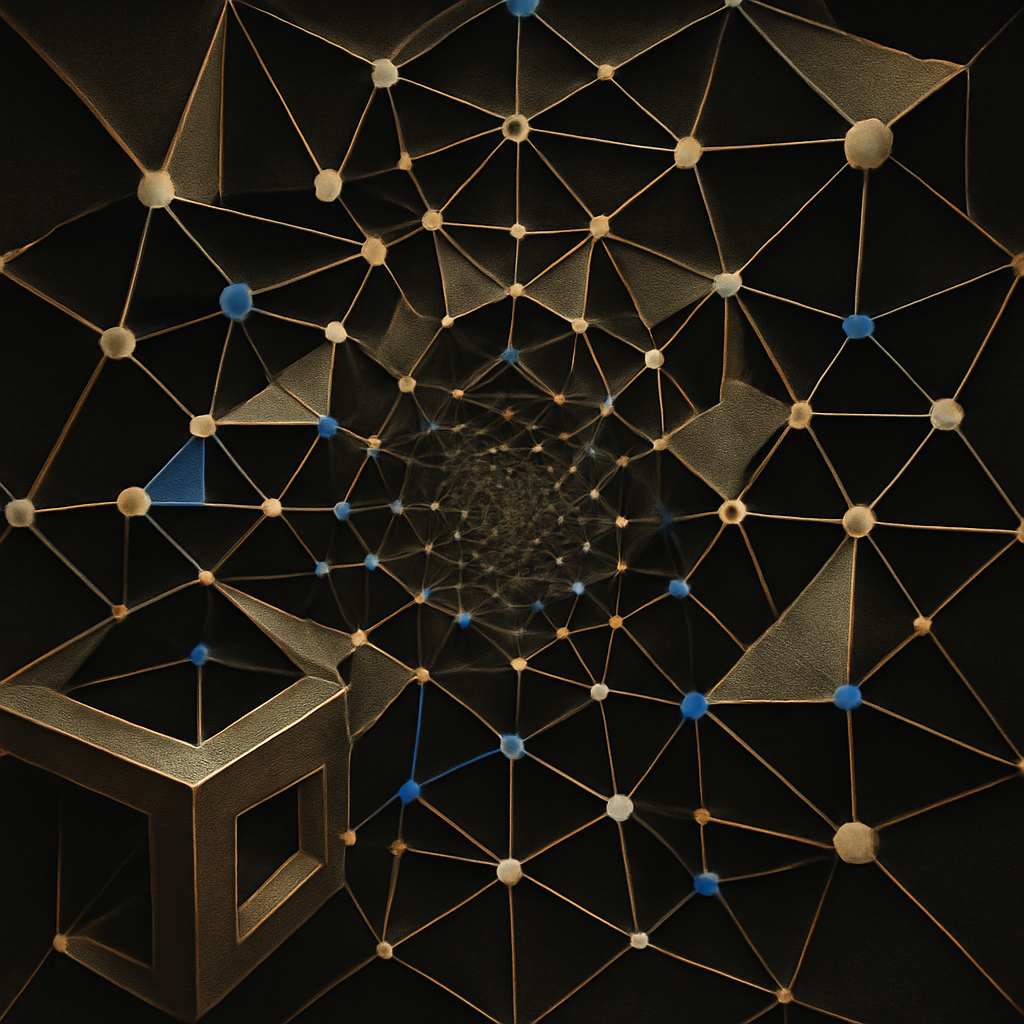
Why Shared Neighbours Predict Missing Edges in Networks
Shared neighbours predict a missing edge because they reveal triadic closure, community structure, and latent proximity—but degree and sampling bias can mislead.
Image provenance and limitation
Source: AI-generated visual interpretation
Creator: Question Everything
Limitation: This image explains or evokes the subject. It is not documentary evidence and should not be used to verify a factual claim.
Evidence
What do we know?
Verified claims with confidence scoring and cited sources.
1 of 3 findings need extra caution. Finding 1 rests on weaker sourcing than the other findings.
Living footnotes
Claims remain in the reading flow. Select a citation number to inspect the source behind it.
01
StatisticalNot confirmed
Shared neighbours provide a topological signal for predicting future or missing network edges.
In a network snapshot, two unconnected nodes may occupy overlapping local neighbourhoods. Common neighbours then act as structural evidence of proximity: co-authors who share collaborators, for example, may be more likely to collaborate later. Liben-Nowell and Kleinberg formalised this link-prediction problem and found that several proximity measures performed 40 to 50 times better than chance on their data, though exogenous events remain difficult to infer from topology alone.
02
ExperimentalSupported
Common-neighbour methods estimate link likelihood from the existing topology of a graph.
A common-neighbour score counts, or otherwise weights, the vertices adjacent to both candidate endpoints. The intuition is local homophily: nodes embedded in partly shared social or functional contexts have greater structural affinity. CCPA extends this family by combining common-neighbour information with centrality, while evaluation across eight standard data sets reported improved predictability relative to established algorithms. Such scores remain correlational; they do not identify the social mechanism that creates an edge.
03
AcademicSupported
Graph neural networks can combine shared-neighbour structure with node and edge features for link prediction.
Traditional predictors include common neighbours, Adamic–Adar, preferential attachment and Katz index. Graph neural networks instead learn representations by aggregating information from graph structure and node or edge attributes, with node-based and subgraph-based approaches offering different expressive power. This can improve on a single local heuristic when relevant features exist, but incomplete graphs, hidden confounding and distribution shift still limit interpretation and out-of-sample reliability.
The complete record below preserves every citation, confidence input and recorded limitation.
Read the full evidence record3 findings · citations · limitations
Evidence review3 findings2 openable sources
01
Finding 1 of 3StatisticalNeeds caution
0/0 verified
Shared neighbours provide a topological signal for predicting future or missing network edges.
In a network snapshot, two unconnected nodes may occupy overlapping local neighbourhoods. Common neighbours then act as structural evidence of proximity: co-authors who share collaborators, for example, may be more likely to collaborate later. Liben-Nowell and Kleinberg formalised this link-prediction problem and found that several proximity measures performed 40 to 50 times better than chance on their data, though exogenous events remain difficult to infer from topology alone.
Not confirmedmodel score 30%
Scored as if sourced, but every citation failed verification.
NO SURVIVING CITATION
›View sources and limits— limits
Supporting passage
In a network snapshot, two unconnected nodes may occupy overlapping local neighbourhoods. Common neighbours then act as structural evidence of proximity: co-authors who share collaborators, for example, may be more likely to collaborate later. Liben-Nowell and Kleinberg formalised this link-prediction problem and found that several proximity measures performed 40 to 50 times better than chance on their data, though exogenous events remain difficult to infer from topology alone.
Citations (0 of 1 survived verification)
Nothing openable. Every citation was removed by provenance validation.
What limits this
All 1 citation on this claim failed verification and were removed. Nothing openable supports it.
02
Finding 2 of 3Experimental
1
0/1 verified
Common-neighbour methods estimate link likelihood from the existing topology of a graph.
A common-neighbour score counts, or otherwise weights, the vertices adjacent to both candidate endpoints. The intuition is local homophily: nodes embedded in partly shared social or functional contexts have greater structural affinity. CCPA extends this family by combining common-neighbour information with centrality, while evaluation across eight standard data sets reported improved predictability relative to established algorithms. Such scores remain correlational; they do not identify the social mechanism that creates an edge.
Supportedmodel score 94%
One source, not peer-reviewed. Thinner than the score suggests.
REFERENCE
›View sources and limits— 1 citation, limits
Supporting passage
A common-neighbour score counts, or otherwise weights, the vertices adjacent to both candidate endpoints. The intuition is local homophily: nodes embedded in partly shared social or functional contexts have greater structural affinity. CCPA extends this family by combining common-neighbour information with centrality, while evaluation across eight standard data sets reported improved predictability relative to established algorithms. Such scores remain correlational; they do not identify the social mechanism that creates an edge.
Rests on a single source. No independent corroboration.
No peer-reviewed source among the citations.
The generator scored this 94%, which would read as “Established”. Its citations reach only “Supported”, so that is what is shown.
03
Finding 3 of 3Academic
1
0/1 verified
Graph neural networks can combine shared-neighbour structure with node and edge features for link prediction.
Traditional predictors include common neighbours, Adamic–Adar, preferential attachment and Katz index. Graph neural networks instead learn representations by aggregating information from graph structure and node or edge attributes, with node-based and subgraph-based approaches offering different expressive power. This can improve on a single local heuristic when relevant features exist, but incomplete graphs, hidden confounding and distribution shift still limit interpretation and out-of-sample reliability.
Supportedmodel score 91%
One source, not peer-reviewed. Thinner than the score suggests.
REFERENCE
›View sources and limits— 1 citation, limits
Supporting passage
Traditional predictors include common neighbours, Adamic–Adar, preferential attachment and Katz index. Graph neural networks instead learn representations by aggregating information from graph structure and node or edge attributes, with node-based and subgraph-based approaches offering different expressive power. This can improve on a single local heuristic when relevant features exist, but incomplete graphs, hidden confounding and distribution shift still limit interpretation and out-of-sample reliability.
Rests on a single source. No independent corroboration.
No peer-reviewed source among the citations.
The generator scored this 91%, which would read as “Established”. Its citations reach only “Supported”, so that is what is shown.
Interactive Exploration
Touch, drag, and discover
These visualizations respond to your curiosity. Interact to go deeper.
process flow
From Shared Context to a Predicted Edge
Represent the graph
Find candidate pairs
Count shared neighbours
Weight and rank
Validate temporally
comparison table
Competing Signals for a Missing Edge
Local overlap
Global or learned structure
Common neighbours
Counts shared adjacent nodes
Sensitive to local clustering
Katz index
Uses paths of varying length
Captures broader connectivity
Graph neural network
Aggregates neighbourhood information
Can incorporate node and edge features
Tap any row to highlight and compare
Visual Gallery
Images & artifacts
Historical images, diagrams, and visual knowledge from Wikimedia Commons.
Perspectives
How is this interpreted?
Enter a viewpoint. Notice what it reveals, what it leaves out, and whether it changes the question for you.
The EmpiricistScientific viewpointLive tension
The strongest scientific account is structural: shared neighbours encode latent proximity, triadic closure or membership in the same densely connected region. Yet this is not universal. Temporal ordering, degree heterogeneity, missing-not-at-random observations and external events can break the relationship. The central debate is therefore not whether common neighbours help on average, but when their marginal information exceeds that of preferential attachment, path-based scores, node attributes or learned subgraph representations.
What this lens notices
01Shared context supplies observable evidence for unobserved proximity.
02Competing scores capture degree, path length and latent features differently.
03Prediction accuracy depends on graph completeness and temporal regime.
Application
Why does this matter to you?
Personal reflections and applications for your life.
Thought experimentPractical
Before trusting a predicted edge, ask whether its shared neighbours are informative or merely high-degree hubs.
Why it changes the question
This separates genuine local similarity from a mechanical popularity effect. It also directs attention toward degree-normalised scores and appropriate baselines.
Try this
Compare common-neighbour counts with Adamic–Adar and preferential-attachment scores on the same candidate pairs.
Media
QE Smart Glass
Curated media selected for this investigation.
QE Glass
YOUTUBE
A system. Four women. Triplets. 15 billion. This isn’t life—it’s a cheat code.
No AI help here — no suggestions, no autocomplete, nothing finishing your sentences. That is deliberate. Working out what you think is effortful, and the effort is the part that changes you: reasoning is trained like a muscle, and a muscle that is always carried gets weaker. Let something else do the thinking and you keep the answer but lose the capacity to have reached it.
Write your current position.
Not what the page says. What you think, having read it.0 words · Nothing written yet.
Sign in to leave a mark. Your draft is saved here in the meantime.