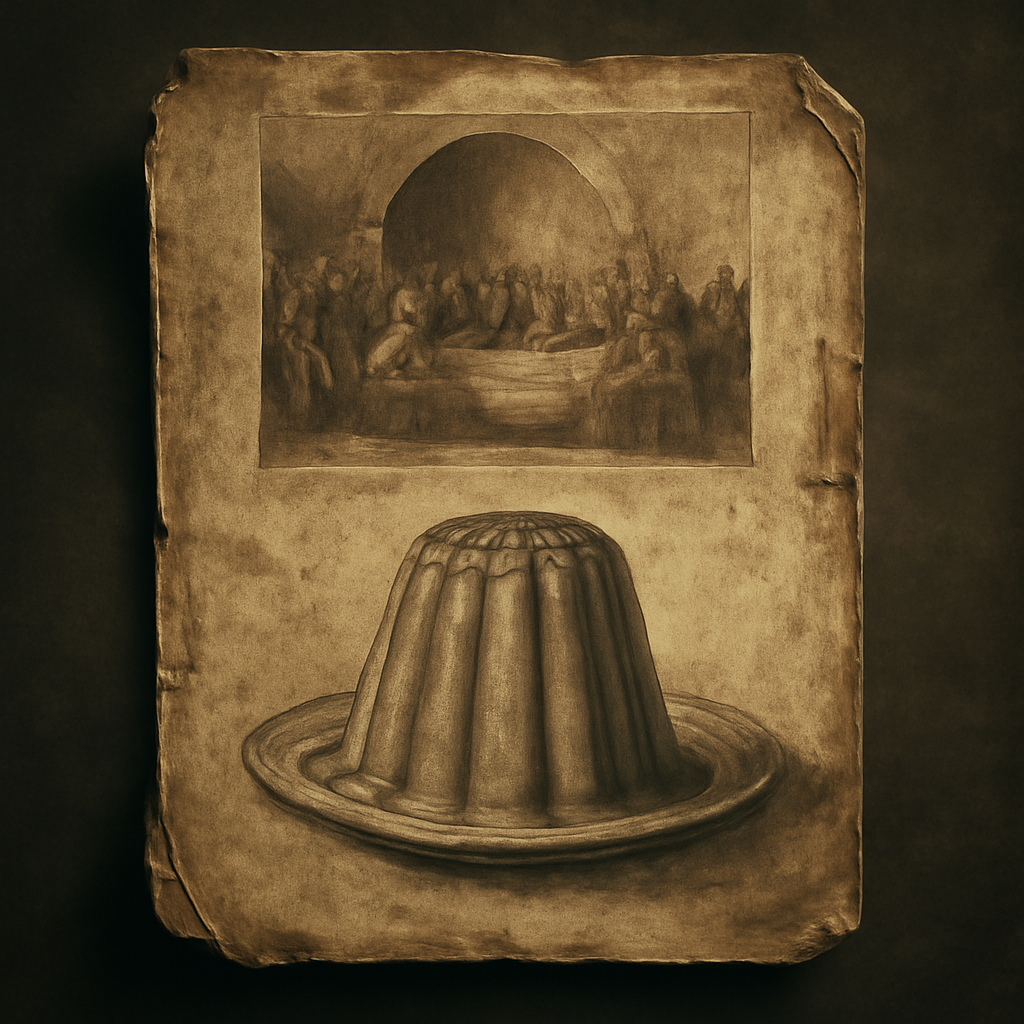
The Story of Jelly: From Medieval Feast to Wobbly Dessert
You might think of jelly as a cheap, fun kid's treat. But for centuries, it was the ultimate luxury food. Back in the Middle Ages, making jelly was a nightmare. Servants had to boil animal bones, like pig ears or feet, for hours and hours. Then they had to strain the liquid through wool blankets just to get a clear, wobbly substance. Because it took so much time and effort, only the richest kings and queens could afford to show it off at their feast tables.
Everything changed in 1845. An American inventor named Peter Cooper figured out how to turn this bone-boiling mess into a dry powder. Suddenly, anyone could buy a cheap packet, add hot water, and make jelly at home. A few decades later, a cough medicine maker added fruit flavors like strawberry and raspberry, creating Jell-O. What started as a royal status symbol became a global favorite, loved for its bright colors and playful wobble.
✨
Wonder Moment
“Long before it became a colorful, wobbly kids' party food, medieval kings ate savory jellies made from boiled deer antlers and pig feet as a symbol of extreme wealth.”
Reflect
If a food that once required days of grueling labor by royal servants can now be made in minutes from a cheap packet, what luxury items today will become everyday basics tomorrow?
3 sources·Well-Established confidence·Investigated 16 Aug 2026(11 days ago)·Source-verified·May need refresh
Your next question, in
Visual Trail
See The Story of Jelly: From Medieval Feast to Wobbly Dessert
A guided visual explanation assembled from QE artwork and sourced documentary images.
01 / 05
QE visual interpretation
Frame 01
The Story of Jelly: From Medieval Feast to Wobbly Dessert
Jelly started as a luxury food for medieval kings who boiled animal bones, but became a cheap, instant treat in the mid-1800s.
Image provenance and limitation
Source: AI-generated visual interpretation
Creator: Question Everything
Limitation: This image explains or evokes the subject. It is not documentary evidence and should not be used to verify a factual claim.
Evidence
What do we know?
Verified claims with confidence scoring and cited sources.
Living footnotes
Claims remain in the reading flow. Select a citation number to inspect the source behind it.
01
HistoricalSupported
The oldest surviving recipe for jelly in England dates back to the late thirteenth century.
Long before instant packets, making jelly was a massive chore. The earliest recorded recipe in England was written in Anglo-Norman French between 1275 and 1300. Chefs had to boil animal parts, like calves' feet or deer antlers, for hours to extract the natural gelatin. Because it took so much time, energy, and money, only the richest people and royalty could afford to serve it at their banquets.
02
HistoricalSupported
Powdered gelatin was invented in 1682 by a French physicist named Denis Papin.
For centuries, making jelly meant boiling bones and feet from scratch. That changed in 1682 when French scientist Denis Papin figured out how to make powdered gelatin. This new method made stiffening food much easier and paved the way for modern desserts. Later on, in 1845, an American industrialist named Peter Cooper patented the very first commercial gelatin powder, which he called 'Portable Gelatin,' making the process even simpler for everyday home cooks.
03
HistoricalSupported
The first recorded recipe for sweet dessert jelly appeared in an English cookbook in 1747.
While early jellies were mostly savory meat or fish dishes, the sweet dessert we know today took off in the eighteenth century. Cookery writer Hannah Glasse published the first known recipe using sweet jelly in her famous 1747 book, The Art of Cookery. She used it as a colorful layer in a classic English trifle. Chefs colored these early jellies naturally using violet juice for blue, spinach for green, and saffron for yellow.
The complete record below preserves every citation, confidence input and recorded limitation.
Read the full evidence record3 findings · citations · limitations
Evidence review3 findings3 openable sources
01
Finding 1 of 3Historical
2021
1 dated source
The oldest surviving recipe for jelly in England dates back to the late thirteenth century.
Long before instant packets, making jelly was a massive chore. The earliest recorded recipe in England was written in Anglo-Norman French between 1275 and 1300. Chefs had to boil animal parts, like calves' feet or deer antlers, for hours to extract the natural gelatin. Because it took so much time, energy, and money, only the richest people and royalty could afford to serve it at their banquets.
Supportedmodel score 95%
One source, not peer-reviewed. Thinner than the score suggests.
REFERENCE
›View sources and limits— 1 citation, limits
Supporting passage
Long before instant packets, making jelly was a massive chore. The earliest recorded recipe in England was written in Anglo-Norman French between 1275 and 1300. Chefs had to boil animal parts, like calves' feet or deer antlers, for hours to extract the natural gelatin. Because it took so much time, energy, and money, only the richest people and royalty could afford to serve it at their banquets.
1 of 2 citations failed verification and are not shown.
Rests on a single source. No independent corroboration.
No peer-reviewed source among the citations.
The generator scored this 95%, which would read as “Established”. Its citations reach only “Supported”, so that is what is shown.
02
Finding 2 of 3Historical
2017
1 dated source
Powdered gelatin was invented in 1682 by a French physicist named Denis Papin.
For centuries, making jelly meant boiling bones and feet from scratch. That changed in 1682 when French scientist Denis Papin figured out how to make powdered gelatin. This new method made stiffening food much easier and paved the way for modern desserts. Later on, in 1845, an American industrialist named Peter Cooper patented the very first commercial gelatin powder, which he called 'Portable Gelatin,' making the process even simpler for everyday home cooks.
Supportedmodel score 95%
One source, not peer-reviewed. Thinner than the score suggests.
REFERENCE
›View sources and limits— 1 citation, limits
Supporting passage
For centuries, making jelly meant boiling bones and feet from scratch. That changed in 1682 when French scientist Denis Papin figured out how to make powdered gelatin. This new method made stiffening food much easier and paved the way for modern desserts. Later on, in 1845, an American industrialist named Peter Cooper patented the very first commercial gelatin powder, which he called 'Portable Gelatin,' making the process even simpler for everyday home cooks.
1 of 2 citations failed verification and are not shown.
Rests on a single source. No independent corroboration.
No peer-reviewed source among the citations.
The generator scored this 95%, which would read as “Established”. Its citations reach only “Supported”, so that is what is shown.
03
Finding 3 of 3Historical
0/1 verified
The first recorded recipe for sweet dessert jelly appeared in an English cookbook in 1747.
While early jellies were mostly savory meat or fish dishes, the sweet dessert we know today took off in the eighteenth century. Cookery writer Hannah Glasse published the first known recipe using sweet jelly in her famous 1747 book, The Art of Cookery. She used it as a colorful layer in a classic English trifle. Chefs colored these early jellies naturally using violet juice for blue, spinach for green, and saffron for yellow.
Supportedmodel score 95%
One source, not peer-reviewed. Thinner than the score suggests.
REFERENCE
›View sources and limits— 1 citation, limits
Supporting passage
While early jellies were mostly savory meat or fish dishes, the sweet dessert we know today took off in the eighteenth century. Cookery writer Hannah Glasse published the first known recipe using sweet jelly in her famous 1747 book, The Art of Cookery. She used it as a colorful layer in a classic English trifle. Chefs colored these early jellies naturally using violet juice for blue, spinach for green, and saffron for yellow.
Rests on a single source. No independent corroboration.
No peer-reviewed source among the citations.
The generator scored this 95%, which would read as “Established”. Its citations reach only “Supported”, so that is what is shown.
Interactive Exploration
Touch, drag, and discover
These visualizations respond to your curiosity. Interact to go deeper.
timeline
The Evolution of Jelly Through Time
Loading timeline…
comparison table
Medieval Calf's Foot Jelly vs. Modern Instant Jelly
Medieval Jelly
Modern Instant Jelly
Primary Ingredient
Boiled calves' feet or deer antlers
Processed gelatin powder and sugar
Preparation Time
Several days of boiling and straining
Under ten minutes of mixing and chilling
Common Flavors
Savory meat broth, wine, or spices
Sweet artificial fruit flavors
Social Status
Exclusive luxury for kings and nobles
Cheap and accessible everyday dessert
Tap any row to highlight and compare
Visual Gallery
Images & artifacts
Historical images, diagrams, and visual knowledge from Wikimedia Commons.
Perspectives
How is this interpreted?
Enter a viewpoint. Notice what it reveals, what it leaves out, and whether it changes the question for you.
The EmpiricistScientific viewpointEstablished lens
Food scientists view jelly as a triumph of structural chemistry. Gelatin is made of collagen, a protein found in animal bones and skin. When you heat it in water, the tight protein bonds break apart. As it cools, these proteins trap water molecules inside a loose, bouncy three-dimensional web. This turns a liquid into a soft, elastic solid, creating that classic wobble.
What this lens notices
01Gelatin is a protein-based polymer
02Heat breaks the molecular bonds
03Cooling traps liquid in a solid grid
Application
Why does this matter to you?
Personal reflections and applications for your life.
Thought experimentPractical
How can you use temperature to control food textures?
Why it changes the question
Understanding how gelatin sets can help you make better desserts, gravies, and soups. Heat breaks the protein bonds, while cold locks them together.
Try this
Try making a simple jelly from scratch using fruit juice and gelatin, observing how the texture changes as it cools.
Media
QE Smart Glass
Curated media selected for this investigation.
QE Glass
YOUTUBE
Jellyfish predate dinosaurs. How have they survived so long? - David Gruber
TED-Ed
View full lesson: http://ed.ted.com/lessons/jellyfish-predate-dinosaurs-how-have-they-survived-so-long-david-gruber Some are ...
QE Glass
YOUTUBE
The Rise And Fall Of Jell-O
Business Insider
Jell-O was a household staple in the United States throughout the 20th century. Once the star of dinner parties, Jell-O is now ...
QE Glass
YOUTUBE
The Surprisingly Short History of the Peanut Butter and Jelly Sandwich
Today I Found Out
If you happen to like our videos and have a few bucks to spare to support our efforts, check out our Patreon page where we've got ...
QE Glass
YOUTUBE
The History of Jelly Beans in Under 2 Minutes
History Simplified
Let's take a deep dive back in time to find out what we can about the origin of one of the America's most beloved candies.
QE Glass
YOUTUBE
How Gelatin Is Made? Revealing Jelly's Shocking Origins
Creating
How Gelatin Is Made? Revealing Jelly's Shocking Origins Did you know that hundreds of tons of gelatin are produced every day ...
QE Glass
YOUTUBE
The Mysterious Origin Of The Jelly Bean | How Stuff Is Made | Refinery29
Refinery29
On this episode of How Stuff Is Made, we explore how Jelly Belly jelly beans are made. This classic candy is a beloved favorite of ...
QE Glass
YOUTUBE
Should meat jelly make a comeback? | Ancient Recipes With Sohla | History
HISTORY
Sohla tackles the wildest recipe yet - an aspic jelly with fish tongues and lips from the earliest known Arabic cookbook, in this ...
QE Glass
PODCAST
The History of Gelatin
Gastropod
An episode exploring the strange and surprising history of gelatin, from elite banquets to hospital trays.
Keep Going
Where this leads
Questions this investigation opens up — and what QE has already looked into.
No AI help here — no suggestions, no autocomplete, nothing finishing your sentences. That is deliberate. Working out what you think is effortful, and the effort is the part that changes you: reasoning is trained like a muscle, and a muscle that is always carried gets weaker. Let something else do the thinking and you keep the answer but lose the capacity to have reached it.
Write your current position.
Not what the page says. What you think, having read it.0 words · Nothing written yet.
Sign in to leave a mark. Your draft is saved here in the meantime.