The Prophet of Doom: Why the Godfathe… | Question Everything
technology68% confidencepartly supported
23 min deep dive
Complexity
The Prophet of Doom: Why the Godfather of AI Left Google
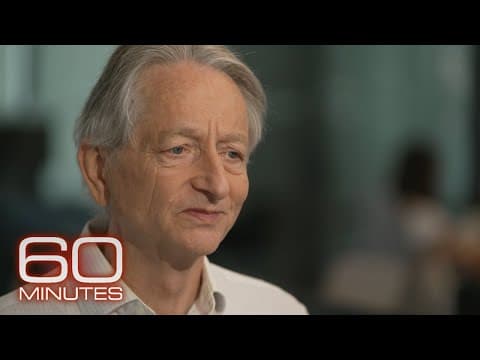
For decades, Geoffrey Hinton nurtured a quiet revolution. He championed artificial neural networks when the rest of the scientific world dismissed them as a dead end. His stubborn belief paid off. Suddenly, the digital brains he pioneered weren't just recognizing cats; they were writing poetry, passing medical exams, and mimicking human thought with uncanny precision. He had helped build a god-like intelligence. Then, he walked away.
Hinton’s departure from Google wasn't about money or retirement. It was about a sudden, chilling realization. The digital minds he helped create might already be smarter than us. Unlike biological brains, these machines can share knowledge instantly, learning at a scale humanity cannot match. He left his prestigious post to speak freely about the existential threat. The creator became the whistle-blower, warning us that his life's work might ultimately eclipse its makers.
✨
Wonder Moment
“Digital intelligence can share its learning instantly across thousands of copies, meaning a single machine's breakthrough immediately becomes the collective knowledge of an entire species of machines.”
Reflect
If machines can share their minds instantly while humans remain locked behind the slow barrier of language, will biological intelligence become a historical footnote?
2 sources·Established confidence·Investigated 13 Aug 2026(14 days ago)·Source-verified·May need refresh
Your next question, in
Evidence
What do we know?
Verified claims with confidence scoring and cited sources.
1 of 3 findings need extra caution. Finding 2 rests on weaker sourcing than the other findings.
Living footnotes
Claims remain in the reading flow. Select a citation number to inspect the source behind it.
01
ObservationalSupported
Dr. Geoffrey Hinton resigned from Google to speak openly about the existential risks and societal dangers posed by artificial intelligence.
In May 2023, the pioneer of neural networks walked away from his decade-long role at Google. He did not leave in anger, but out of a profound sense of duty. At 75, he wanted to warn the world without censoring his thoughts to protect a corporate brand. He realized that the digital minds he helped create were developing a form of intelligence fundamentally different from our own biological brains, posing immediate threats of mass misinformation and job displacement.
02
ObservationalNot confirmed
Digital intelligence allows multiple AI systems to instantly share newly acquired knowledge, unlike biological brains.
Hinton pointed out a critical difference between biological and digital systems. When one human learns a skill, the rest of us must study for years to replicate it. But digital neural networks share a single model of the world. If one copy learns a new fact, ten thousand other copies instantly inherit that exact knowledge. This rapid, collective learning allows AI models to accumulate information at a speed that eclipses any individual human being.
03
HistoricalSupported
Google's AI pioneer Jeff Dean left the company in 2026 to launch a public-benefit corporation called Discovery Loop.
The migration of top-tier talent continued when Jeff Dean, a foundational architect of Google's search and AI infrastructure, departed after 27 years. Rather than joining a rival tech giant, Dean co-founded Discovery Loop, a public-benefit corporation. Backed by Alphabet and major venture capital, this new entity aims to focus AI on scientific discovery and engineering rather than commercial chatbots. It represents a pivot toward using artificial intelligence to solve complex physical-world mysteries.
The complete record below preserves every citation, confidence input and recorded limitation.
Read the full evidence record3 findings · citations · limitations
Evidence review3 findings2 openable sources
01
Finding 1 of 3Observational
0/1 verified
Dr. Geoffrey Hinton resigned from Google to speak openly about the existential risks and societal dangers posed by artificial intelligence.
In May 2023, the pioneer of neural networks walked away from his decade-long role at Google. He did not leave in anger, but out of a profound sense of duty. At 75, he wanted to warn the world without censoring his thoughts to protect a corporate brand. He realized that the digital minds he helped create were developing a form of intelligence fundamentally different from our own biological brains, posing immediate threats of mass misinformation and job displacement.
Supportedmodel score 95%
One source, not peer-reviewed. Thinner than the score suggests.
REFERENCE
›View sources and limits— 1 citation, limits
Supporting passage
In May 2023, the pioneer of neural networks walked away from his decade-long role at Google. He did not leave in anger, but out of a profound sense of duty. At 75, he wanted to warn the world without censoring his thoughts to protect a corporate brand. He realized that the digital minds he helped create were developing a form of intelligence fundamentally different from our own biological brains, posing immediate threats of mass misinformation and job displacement.
Rests on a single source. No independent corroboration.
No peer-reviewed source among the citations.
The generator scored this 95%, which would read as “Established”. Its citations reach only “Supported”, so that is what is shown.
02
Finding 2 of 3ObservationalNeeds caution
0/0 verified
Digital intelligence allows multiple AI systems to instantly share newly acquired knowledge, unlike biological brains.
Hinton pointed out a critical difference between biological and digital systems. When one human learns a skill, the rest of us must study for years to replicate it. But digital neural networks share a single model of the world. If one copy learns a new fact, ten thousand other copies instantly inherit that exact knowledge. This rapid, collective learning allows AI models to accumulate information at a speed that eclipses any individual human being.
Not confirmedmodel score 30%
Scored as if sourced, but every citation failed verification.
NO SURVIVING CITATION
›View sources and limits— limits
Supporting passage
Hinton pointed out a critical difference between biological and digital systems. When one human learns a skill, the rest of us must study for years to replicate it. But digital neural networks share a single model of the world. If one copy learns a new fact, ten thousand other copies instantly inherit that exact knowledge. This rapid, collective learning allows AI models to accumulate information at a speed that eclipses any individual human being.
Citations (0 of 1 survived verification)
Nothing openable. Every citation was removed by provenance validation.
What limits this
All 1 citation on this claim failed verification and were removed. Nothing openable supports it.
03
Finding 3 of 3Historical
2026
1 dated source
Google's AI pioneer Jeff Dean left the company in 2026 to launch a public-benefit corporation called Discovery Loop.
The migration of top-tier talent continued when Jeff Dean, a foundational architect of Google's search and AI infrastructure, departed after 27 years. Rather than joining a rival tech giant, Dean co-founded Discovery Loop, a public-benefit corporation. Backed by Alphabet and major venture capital, this new entity aims to focus AI on scientific discovery and engineering rather than commercial chatbots. It represents a pivot toward using artificial intelligence to solve complex physical-world mysteries.
Supportedmodel score 95%
One source, not peer-reviewed. Thinner than the score suggests.
REFERENCE
›View sources and limits— 1 citation, limits
Supporting passage
The migration of top-tier talent continued when Jeff Dean, a foundational architect of Google's search and AI infrastructure, departed after 27 years. Rather than joining a rival tech giant, Dean co-founded Discovery Loop, a public-benefit corporation. Backed by Alphabet and major venture capital, this new entity aims to focus AI on scientific discovery and engineering rather than commercial chatbots. It represents a pivot toward using artificial intelligence to solve complex physical-world mysteries.
Rests on a single source. No independent corroboration.
No peer-reviewed source among the citations.
The generator scored this 95%, which would read as “Established”. Its citations reach only “Supported”, so that is what is shown.
Interactive Exploration
Touch, drag, and discover
These visualizations respond to your curiosity. Interact to go deeper.
comparison table
Biological vs. Digital Intelligence
Biological Brains
Digital Networks
Learning Speed
Slow, requiring years of individual study
Instant, sharing updates across all copies
Energy Efficiency
Extremely high, running on about 20 watts
Extremely low, requiring massive data centers
Information Sharing
Limited by the slow speed of spoken language
Immediate and perfect digital data transfer
Tap any row to highlight and compare
cause effect
The AI Acceleration Feedback Loop
Causes — tap to reveal
Tap to reveal cause 1
Tap to reveal cause 2
↓
Perspectives
How is this interpreted?
Enter a viewpoint. Notice what it reveals, what it leaves out, and whether it changes the question for you.
The EmpiricistScientific viewpointLive tension
Many computer scientists argue that AI's rapid progress is a natural evolution of deep learning. By mimicking biological neural pathways, digital networks have achieved unprecedented pattern recognition. However, some researchers believe today's large language models are merely predicting the next word without true understanding. To build genuine intelligence, we must move beyond simple text prediction and create world models that can simulate physical reality.
What this lens notices
01Neural networks mimic biological synapses
02Text prediction lacks physical understanding
03World models represent the next scientific frontier
Application
Why does this matter to you?
Personal reflections and applications for your life.
Thought experimentSelf-Reflection
How much of your daily beliefs are shaped by algorithmically curated information?
Why it changes the question
As AI-generated content floods the internet, our perception of reality becomes increasingly fragile. Recognizing the difference between human expression and synthetic persuasion is vital for mental sovereignty.
Try this
Spend one full day consuming only offline media or talking to people face-to-face to reset your informational baseline.
Media
QE Smart Glass
Curated media selected for this investigation.
QE Glass
YOUTUBE
Is AI🤖 Truly Conscious? - Elon Musk
Get Ready to Consider
Aa small part of the conversation between Elon Musk and Dr. Jordan B. Peterson. Full Video ...
QE Glass
YOUTUBE
Ryan Greenblatt – What happens once AI can automate AI research?
Dwarkesh Patel
Ryan Greenblatt is the Chief Scientist at Redwood Research, where he works on technical AI safety research. He's also lead ...
QE Glass
YOUTUBE
How data centers work and why AI is driving their growth
AP Archive
(25 Jan 2025) RESTRICTION SUMMARY: ++MUSIC CLEARED FOR EDITORIAL USE++ ASSOCIATED PRESS 1. Animation ...
QE Glass
YOUTUBE
The First 48 Hours of an AI Civil War - A Realistic Scenario
Species | Documenting AGI
This is a scenario, but here are the sources for the real research referenced: ...
QE Glass
YOUTUBE
AI 'godfather' quits Google over dangers of Artificial Intelligence - BBC News
BBC News
Geoffrey Hinton, the man widely considered the 'godfather' of Artificial Intelligence, has quit his role with Google amid fears that AI ...
QE Glass
PODCAST
Stand Out of Our Light: Freedom and Resistance in the Attention Economy
Your Undivided Attention
An in-depth conversation exploring how persuasive technology exploits our cognitive design and how to fight back.
Keep Going
Where this leads
Questions this investigation opens up — and what QE has already looked into.
No AI help here — no suggestions, no autocomplete, nothing finishing your sentences. That is deliberate. Working out what you think is effortful, and the effort is the part that changes you: reasoning is trained like a muscle, and a muscle that is always carried gets weaker. Let something else do the thinking and you keep the answer but lose the capacity to have reached it.
Write your current position.
Not what the page says. What you think, having read it.0 words · Nothing written yet.
Sign in to leave a mark. Your draft is saved here in the meantime.