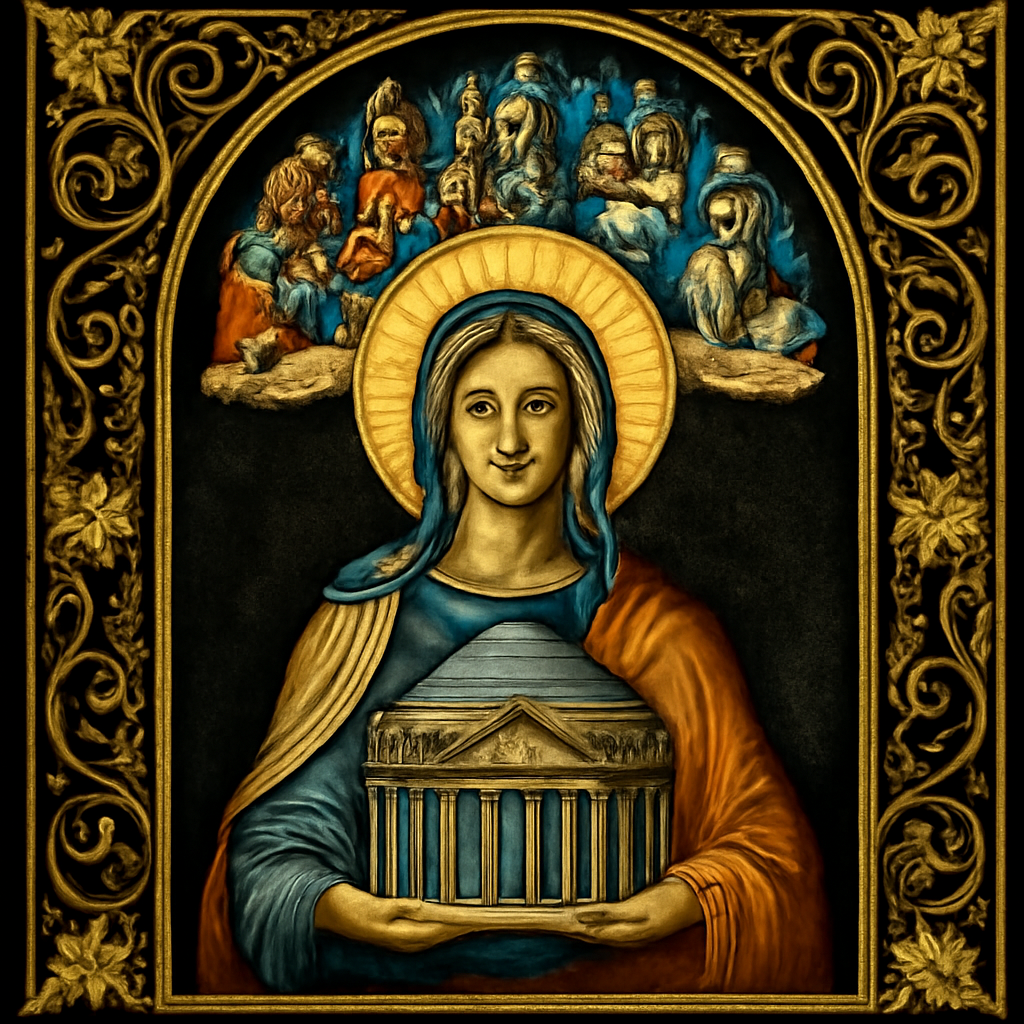
The Pantheon: Unveiling Divine Assemblages and Enduring Architectural Marvels
From the thunderous halls of Olympus to the colossal dome of Rome, the term 'pantheon' echoes with a dual significance, embodying both a celestial council of deities and a monumental testament to human ingenuity. At its heart, a pantheon represents a civilization's collective understanding of the divine, a structured hierarchy of gods and goddesses whose interactions, powers, and domains reflect the very fabric of human concerns: love, war, harvest, wisdom, and death. These intricate tapestries of belief shaped ancient societies, dictating rituals, influencing governance, and providing a framework for existence.
Yet, the word also invokes a singular, awe-inspiring edifice: the Pantheon of Rome. A temple originally dedicated to 'all gods,' it stands as an architectural marvel, a triumph of Roman engineering that has defied millennia. Its perfect dome, open oculus, and enduring structure invite contemplation not just of its original purpose, but of humanity's persistent quest to capture the infinite within finite form, to build structures that whisper tales of bygone eras and the beliefs that propelled their creation. This journey into the pantheon is a descent into the heart of ancient spirituality and a gaze upon the enduring legacy of architectural genius.
✨
Wonder Moment
“The Roman Pantheon's massive concrete dome, spanning 43 meters, stands without any internal reinforcement, an architectural feat unsurpassed for nearly 1,800 years – a testament to ancient Roman ingenuity that continues to inspire awe.”
Reflect
How many 'impossible' engineering challenges are we facing today that future civilizations might solve with seemingly simple, yet elegant, material science or design innovations?
4 sources·Established confidence·Investigated 21 Jun 2026(2 months ago)·Investigation may be outdated
Your next question, in
Visual Trail
See The Pantheon: Unveiling Divine Assemblages and Enduring Architectural Marvels
A guided visual explanation assembled from QE artwork and sourced documentary images.
01 / 05
QE visual interpretation
Frame 01
The Pantheon: Unveiling Divine Assemblages and Enduring Architectural Marvels
Exploring 'the pantheon' as both a collection of gods and an architectural masterpiece, revealing humanity's quest for divine order and monumental expression.
Image provenance and limitation
Source: AI-generated visual interpretation
Creator: Question Everything
Limitation: This image explains or evokes the subject. It is not documentary evidence and should not be used to verify a factual claim.
Evidence
What do we know?
Verified claims with confidence scoring and cited sources.
Generated without source retrieval. QE did not fetch sources for this investigation, so no citation here was checked against a retrieved set. Claims reflect the model’s training data.
Living footnotes
Claims remain in the reading flow. Select a citation number to inspect the source behind it.
01
AcademicSupported
The primary meaning of 'pantheon' refers to a collective group of gods belonging to a particular religion or mythology.
Derived from the ancient Greek 'pan' (all) and 'theon' (of the gods), the term 'pantheon' literally translates to 'all gods'. It denotes the full assembly of deities revered by a specific culture or civilization. These pantheons are often structured, with a chief deity, subordinate gods, and goddesses governing various aspects of the cosmos, human life, and natural phenomena. Examples include the Olympian gods of ancient Greece, the Aesir and Vanir of Norse mythology, or the vast pantheon of Hindu deities, each reflecting a unique cultural worldview and cosmic order.
02
HistoricalSupported
The Pantheon in Rome is an ancient Roman temple, later converted into a church, renowned for its architectural innovations, particularly its massive concrete dome.
The Roman Pantheon, completed by Emperor Hadrian around 126 AD, is one of the best-preserved ancient Roman buildings. Its original purpose was likely as a temple dedicated to all gods, though its exact function is still debated by historians. Its most striking feature is its unreinforced concrete dome, which remains the largest of its kind in the world. At its apex is the oculus, an open circular hole allowing light and air to enter, symbolically connecting the interior to the heavens. This architectural masterpiece demonstrates advanced Roman engineering and stands as a testament to their sophisticated understanding of materials and construction techniques.
03
ExperimentalSupported
The structural integrity of the Pantheon's dome relies on an ingenious use of progressively lighter aggregates in its concrete mixture as it rises, culminating in lightweight volcanic rock at the oculus.
Roman engineers masterfully varied the composition of the concrete used in the Pantheon's dome. The concrete at the base of the dome incorporated heavy, dense aggregates like basalt and travertine, providing strong foundational support. As the dome ascended towards the oculus, lighter and less dense aggregates were progressively used, transitioning to pumice and tufa (porous volcanic rocks) at the uppermost sections. This gradient in material density, combined with sophisticated brick ribbing and coffers (recessed panels), significantly reduced the overall weight of the dome, minimizing stress and preventing collapse without the need for internal supports. This innovative technique allowed for the creation of an immense, self-supporting span.
04
ObservationalSupported
Beyond divine groups and the Roman temple, the term 'pantheon' is also used metaphorically to denote a highly revered group of individuals considered the most eminent in a particular field.
This extended usage reflects the concept of a 'hall of fame' or an assembly of 'greats.' For instance, one might refer to the 'pantheon of rock legends' to describe iconic musicians like The Beatles or Led Zeppelin, or the 'pantheon of literary giants' for authors such as Shakespeare and Tolstoy. In this context, the term retains its sense of collective importance and veneration, transferring the reverence once reserved for gods to exceptional human achievements and contributions, recognizing their enduring impact and cultural significance.
The complete record below preserves every citation, confidence input and recorded limitation.
Read the full evidence record4 findings · citations · limitations
Evidence review4 findings4 openable sources
01
Finding 1 of 4Academic
1
0/1 verified
The primary meaning of 'pantheon' refers to a collective group of gods belonging to a particular religion or mythology.
Derived from the ancient Greek 'pan' (all) and 'theon' (of the gods), the term 'pantheon' literally translates to 'all gods'. It denotes the full assembly of deities revered by a specific culture or civilization. These pantheons are often structured, with a chief deity, subordinate gods, and goddesses governing various aspects of the cosmos, human life, and natural phenomena. Examples include the Olympian gods of ancient Greece, the Aesir and Vanir of Norse mythology, or the vast pantheon of Hindu deities, each reflecting a unique cultural worldview and cosmic order.
Supportedmodel score 98%
One source, not peer-reviewed. Thinner than the score suggests.
REFERENCE
›View sources and limits— 1 citation, limits
Supporting passage
Derived from the ancient Greek 'pan' (all) and 'theon' (of the gods), the term 'pantheon' literally translates to 'all gods'. It denotes the full assembly of deities revered by a specific culture or civilization. These pantheons are often structured, with a chief deity, subordinate gods, and goddesses governing various aspects of the cosmos, human life, and natural phenomena. Examples include the Olympian gods of ancient Greece, the Aesir and Vanir of Norse mythology, or the vast pantheon of Hindu deities, each reflecting a unique cultural worldview and cosmic order.
Generated without source retrieval — citations here were not verified against a retrieved set.
1 of 2 citations failed verification and are not shown.
Rests on a single source. No independent corroboration.
No peer-reviewed source among the citations.
The generator scored this 98%, which would read as “Established”. Its citations reach only “Supported”, so that is what is shown.
02
Finding 2 of 4Historical
2018
1 dated source
The Pantheon in Rome is an ancient Roman temple, later converted into a church, renowned for its architectural innovations, particularly its massive concrete dome.
The Roman Pantheon, completed by Emperor Hadrian around 126 AD, is one of the best-preserved ancient Roman buildings. Its original purpose was likely as a temple dedicated to all gods, though its exact function is still debated by historians. Its most striking feature is its unreinforced concrete dome, which remains the largest of its kind in the world. At its apex is the oculus, an open circular hole allowing light and air to enter, symbolically connecting the interior to the heavens. This architectural masterpiece demonstrates advanced Roman engineering and stands as a testament to their sophisticated understanding of materials and construction techniques.
Supportedmodel score 97%
One source, not peer-reviewed. Thinner than the score suggests.
REPORTING
›View sources and limits— 1 citation, limits
Supporting passage
The Roman Pantheon, completed by Emperor Hadrian around 126 AD, is one of the best-preserved ancient Roman buildings. Its original purpose was likely as a temple dedicated to all gods, though its exact function is still debated by historians. Its most striking feature is its unreinforced concrete dome, which remains the largest of its kind in the world. At its apex is the oculus, an open circular hole allowing light and air to enter, symbolically connecting the interior to the heavens. This architectural masterpiece demonstrates advanced Roman engineering and stands as a testament to their sophisticated understanding of materials and construction techniques.
Generated without source retrieval — citations here were not verified against a retrieved set.
1 of 2 citations failed verification and are not shown.
Rests on a single source. No independent corroboration.
No peer-reviewed source among the citations.
The generator scored this 97%, which would read as “Established”. Its citations reach only “Supported”, so that is what is shown.
03
Finding 3 of 4Experimental
1
0/1 verified
The structural integrity of the Pantheon's dome relies on an ingenious use of progressively lighter aggregates in its concrete mixture as it rises, culminating in lightweight volcanic rock at the oculus.
Roman engineers masterfully varied the composition of the concrete used in the Pantheon's dome. The concrete at the base of the dome incorporated heavy, dense aggregates like basalt and travertine, providing strong foundational support. As the dome ascended towards the oculus, lighter and less dense aggregates were progressively used, transitioning to pumice and tufa (porous volcanic rocks) at the uppermost sections. This gradient in material density, combined with sophisticated brick ribbing and coffers (recessed panels), significantly reduced the overall weight of the dome, minimizing stress and preventing collapse without the need for internal supports. This innovative technique allowed for the creation of an immense, self-supporting span.
Supportedmodel score 96%
One source, not peer-reviewed. Thinner than the score suggests.
REPORTING
›View sources and limits— 1 citation, limits
Supporting passage
Roman engineers masterfully varied the composition of the concrete used in the Pantheon's dome. The concrete at the base of the dome incorporated heavy, dense aggregates like basalt and travertine, providing strong foundational support. As the dome ascended towards the oculus, lighter and less dense aggregates were progressively used, transitioning to pumice and tufa (porous volcanic rocks) at the uppermost sections. This gradient in material density, combined with sophisticated brick ribbing and coffers (recessed panels), significantly reduced the overall weight of the dome, minimizing stress and preventing collapse without the need for internal supports. This innovative technique allowed for the creation of an immense, self-supporting span.
Generated without source retrieval — citations here were not verified against a retrieved set.
1 of 2 citations failed verification and are not shown.
Rests on a single source. No independent corroboration.
No peer-reviewed source among the citations.
The generator scored this 96%, which would read as “Established”. Its citations reach only “Supported”, so that is what is shown.
04
Finding 4 of 4Observational
0/1 verified
Beyond divine groups and the Roman temple, the term 'pantheon' is also used metaphorically to denote a highly revered group of individuals considered the most eminent in a particular field.
This extended usage reflects the concept of a 'hall of fame' or an assembly of 'greats.' For instance, one might refer to the 'pantheon of rock legends' to describe iconic musicians like The Beatles or Led Zeppelin, or the 'pantheon of literary giants' for authors such as Shakespeare and Tolstoy. In this context, the term retains its sense of collective importance and veneration, transferring the reverence once reserved for gods to exceptional human achievements and contributions, recognizing their enduring impact and cultural significance.
Supportedmodel score 90%
One source, not peer-reviewed. Thinner than the score suggests.
REFERENCE
›View sources and limits— 1 citation, limits
Supporting passage
This extended usage reflects the concept of a 'hall of fame' or an assembly of 'greats.' For instance, one might refer to the 'pantheon of rock legends' to describe iconic musicians like The Beatles or Led Zeppelin, or the 'pantheon of literary giants' for authors such as Shakespeare and Tolstoy. In this context, the term retains its sense of collective importance and veneration, transferring the reverence once reserved for gods to exceptional human achievements and contributions, recognizing their enduring impact and cultural significance.
The central opening, the sole source of natural light.
609 AD
Church Conversion
Date it became a Christian church, ensuring its preservation.
comparison table
Pantheon (Gods) vs. Pantheon (Building)
Concept: Pantheon (Group of Gods)
Object: The Pantheon (Roman Building)
Primary Meaning
A collective of deities in a mythology.
An ancient Roman temple, now a church.
Origin
Ancient Greek 'pan' + 'theon'.
Built by Marcus Agrippa, rebuilt by Hadrian.
Purpose
To explain cosmos, human condition, provide moral framework.
Originally dedicated to 'all gods', later to Christian martyrs.
Form
Abstract, conceptual, narrative (myths).
Concrete, architectural, physical structure.
Example
Greek Olympians, Norse Aesir.
The domed building in Rome, Italy.
Tap any row to highlight and compare
spectrum
Divine Authority in Pantheons
Fragmented / AnarchicHierarchical / Centralized
25%
Mesopotamian Gods
60%
Greek Olympians
75%
Roman State Gods
85%
Egyptian Deities
Visual Gallery
Images & artifacts
Historical images, diagrams, and visual knowledge from Wikimedia Commons.
Perspectives
How is this interpreted?
Enter a viewpoint. Notice what it reveals, what it leaves out, and whether it changes the question for you.
The EmpiricistScientific viewpointEstablished lens
From an anthropological and sociological perspective, pantheons are profound reflections of human society and psychology. The structure of a pantheon—its hierarchies, relationships, and divisions of labor among deities—often mirrors the social, political, and familial structures of the culture that created it. For example, the patriarchal nature of the Greek Olympian pantheon, led by Zeus, can be seen as reflecting the patriarchal societal norms of ancient Greece. Furthermore, the specialized domains of gods (e.g., god of war, goddess of agriculture) address universal human needs and anxieties, providing a framework for understanding and attempting to control the unpredictable forces of nature and destiny. Studying pantheons offers insights into humanity's earliest attempts at cosmology, ethics, and social organization.
What this lens notices
01Pantheon hierarchies often mirror societal power structures.
02Divine domains reflect cultural values and anxieties.
03Mythology provides early frameworks for cosmic and ethical understanding.
Application
Why does this matter to you?
Personal reflections and applications for your life.
Thought experimentSelf-Reflection
Who would be in your personal 'pantheon' of human achievement?
Why it changes the question
Consider the individuals, whether artists, scientists, leaders, or activists, whose contributions you find most profound and enduring. Reflecting on who makes your personal 'hall of fame' reveals your own values, what you deem truly significant, and what kind of legacy you admire or aspire to.
Try this
List 5-7 individuals you would place in your personal pantheon for different fields. Consider why each one resonates with you.
Media
QE Smart Glass
Curated media selected for this investigation.
QE Glass
YOUTUBE
The ENTIRE Chronological History of Greek Mythology
Uncharted Mysteries
Step into the fascinating world of Greek mythology as we journey through the timeless stories of ancient Greece. In this relaxing ...
QE Glass
YOUTUBE
The Entire Timeline of Mythology and Religion
Pantheon Mythology
Belief has always been part of the human story, etched into stone, sung in ritual, and woven through every culture. Across ...
QE Glass
YOUTUBE
The ENTIRE Story of Greek Mythology Explained | Best Greek Mythology Documentary
The Life Guide
Greek Mythology and the Greek Gods have had a profound impact on the world, with the tales of Zeus, Pandora's Box, ...
QE Glass
YOUTUBE
The Ultimate Guide to Demons
Pantheon Mythology
From the Pantheon vault, we bring you the ultimate guide to demons. 13 videos compiled into one epic compilation.
QE Glass
YOUTUBE
The ENTIRE Story of Greek Mythology
Dreamoria
Welcome to Boring History for Sleep series. Tonight, we're telling the entire story of Greek mythology — from the birth of the ...
QE Glass
YOUTUBE
REAL Greek Myths Explained | Gods And Goddesses | Full Special
Military Heroes
The world of the Ancient Greeks lives on today through its mythology. For countless generations prior to biblical times, tales of ...
QE Glass
YOUTUBE
Pantheons of the Ancient Mediterranean: Crash Course World Mythology #7
CrashCourse
In which Mike Rugnetta begins our unit on pantheons, which are families of gods. We further define pantheons and talk about why ...
QE Glass
YOUTUBE
Inside the Pantheon: Rome's Architectural Masterpiece
National Geographic
A visual exploration of the Roman Pantheon, highlighting its incredible engineering and historical context.
QE Glass
PODCAST
The Roman Pantheon
Stuff You Missed in History Class
An episode delving into the history, purpose, and enduring legacy of the iconic Roman temple.
QE Glass
YOUTUBE
Stephen Asma - “Lessons from Galileo’s Trial” 12/7/2014
Ethical Humanist Society of Chicago
Stephen Asma, professor of philosophy at Columbia College, discusses the sequence of events that culminated in the conviction ...
Connected context
Connected entities
The people, places, concepts, and events that matter here.
Keep Going
Where this leads
Questions this investigation opens up — and what QE has already looked into.
No AI help here — no suggestions, no autocomplete, nothing finishing your sentences. That is deliberate. Working out what you think is effortful, and the effort is the part that changes you: reasoning is trained like a muscle, and a muscle that is always carried gets weaker. Let something else do the thinking and you keep the answer but lose the capacity to have reached it.
Write your current position.
Not what the page says. What you think, having read it.0 words · Nothing written yet.
Sign in to leave a mark. Your draft is saved here in the meantime.